
A Pakistani student completed his undergraduate studies at a university in Liaoning, China, majoring in Electronic Engineering and Automation. He was awarded a Bachelor of Engineering and later left China before arranging the academic documents he needed for use in Belgium.
By the time the documents were required, returning to Liaoning simply to deal with notarization would have been inconvenient. For this case, we were able to work from clear scanned copies and arrange the Chinese notarization and Apostille after the graduate had already left China.
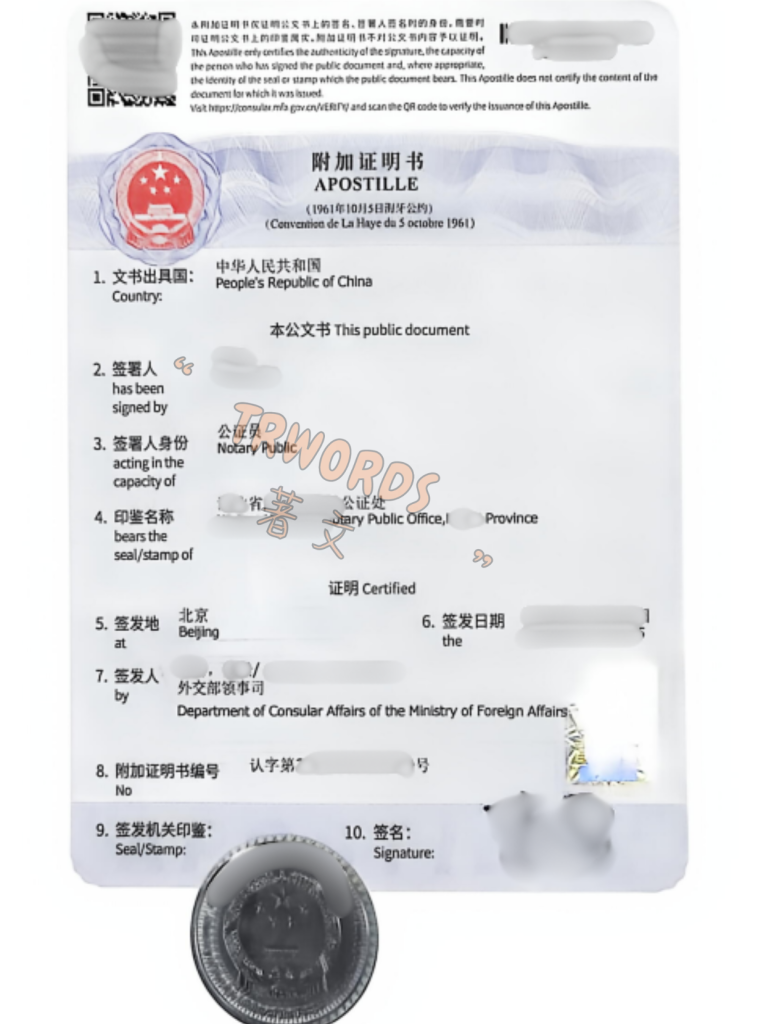
Three Academic Documents, Three Different Roles
The client needed three university documents: his Degree Certificate, Graduation Certificate and Academic Transcript. Although they all relate to the same undergraduate programme, each records a different part of his academic history.
The Graduation Certificate confirms that the student completed the programme and graduated, while the Degree Certificate records the academic degree awarded by the university. The Academic Transcript provides the detailed course and grade record, so a receiving institution may ask for all three rather than treating them as interchangeable documents.
Why Does the Degree Say “Bachelor of Engineering”?
International graduates are very familiar with degree titles such as Bachelor of Arts and Bachelor of Science. Chinese universities also award bachelor’s degrees according to academic discipline categories, which means graduates may encounter titles such as Bachelor of Engineering, Bachelor of Economics, Bachelor of Management or Bachelor of Medicine, depending on the programme concerned.
China’s current Degree Law provides that academic degrees are awarded according to academic disciplines and professional degree categories. Engineering is also a recognised discipline category within China’s higher education system.
That distinction matters in this case. Electronic Engineering and Automation describes what the student studied, while Bachelor of Engineering describes the degree awarded by the university.
The Transcript Issue International Graduates Often Do Not Expect
The Academic Transcript created another practical issue. Many Chinese universities provide international students with an English transcript or a bilingual Chinese-English transcript, and students naturally assume that the official English version will be sufficient for any later notarization.
In practice, some Chinese notary offices still require a Chinese transcript issued by the university as part of their supporting evidence. If a graduate only received an English transcript, the notary may ask the applicant to contact the university and obtain a Chinese version before the notarization can proceed.
This is worth checking before starting the process, especially for graduates who have already returned overseas. Requesting an additional university document after graduation can take longer than preparing the notarization itself, especially during university summer and winter holidays when administrative offices may respond more slowly. Checking the transcript format early can therefore save valuable time.
Already Left China? You May Still Be Able to Arrange the Notarization
In this case, the Pakistani graduate had already left China and did not need to return to Liaoning to complete the process. Clear scans of the academic documents and passport were sufficient for us to start the application, subject to the notary office’s document review.
Additional verification may still be requested depending on the university, document type and notary office handling the case. For this particular application, the complete notarization and China Apostille process took approximately 10–12 working days.
This is especially useful for international graduates who only discover the requirement after moving to another country. Chinese academic documents can often still be dealt with after departure, so being physically outside China does not automatically mean travelling back to the city where the university is located.
English Notarial Certificates for This Belgium Case
The Degree Certificate, Graduation Certificate and Academic Transcript were prepared as English-Chinese notarial certificates for this case. Each academic document was reviewed and incorporated into the corresponding notarial documentation for overseas use.
English is commonly selected for international academic applications, although the receiving institution may have its own language requirements. If a Belgian university, employer or other receiving organisation specifies a particular language or document format, it is worth confirming that requirement before the Chinese notarization is prepared.
From a Chinese University to Belgium
After notarization, the documents proceeded to a China Apostille. Belgium’s official guidance confirms that Chinese documents requiring authentication for use in Belgium can be notarized in China and then apostilled by the Chinese Ministry of Foreign Affairs or an authorised local Foreign Affairs Office; further legalization by the Belgian Embassy or Consulate General is no longer part of that authentication route.
For this case, the document route was therefore straightforward: Chinese academic documents → Chinese notarization → China Apostille → use in Belgium. The more useful work happened before the Apostille stage—checking the transcript format, preserving the correct Chinese degree title and arranging the documents after the graduate had already left China.
For international students graduating from Chinese universities, these details can matter several years after graduation. Keeping copies of both Chinese and English academic records, understanding exactly which degree was awarded, and checking the receiving institution’s requirements before notarization can make the later overseas-use process much easier.