
Foreign professionals moving to Guangzhou sometimes encounter an unexpected document issue. They may already have Chinese translations prepared by a registered translation company in another city, only to find that Guangzhou applies a different standard when foreign-language documents are submitted for a work permit.
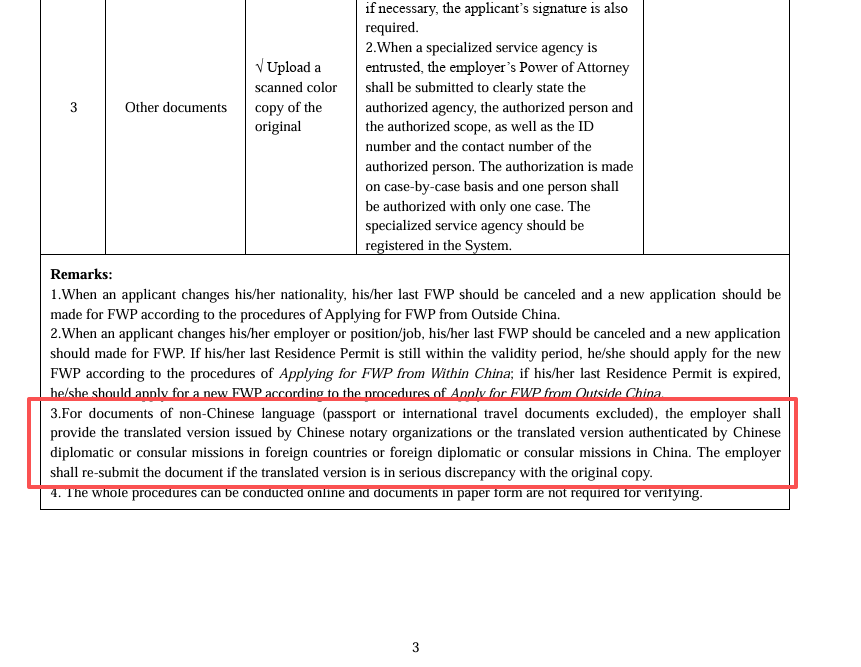
The Guangzhou Science and Technology Bureau has addressed this question directly. Its published guidance states that foreign-language documents should be accompanied by translations issued by a Chinese notary office.
That small difference can change how documents such as an overseas degree, police clearance or professional qualification certificate need to be prepared.
A Normal Translation Company Stamp May Not Be Enough in Guangzhou
In many Chinese cities, foreign-language documents for official procedures are commonly translated by a legally registered translation company, with the company’s official seal affixed to the Chinese translation. Guangzhou’s work permit practice is more specific because the translation is expected to come through a Chinese notary office.
This is particularly relevant for foreigners who previously worked in Beijing, Shanghai, Shenzhen or another Chinese city. A translation that was accepted for an earlier procedure elsewhere may therefore need to be prepared again when the document has to be submitted for a Guangzhou work permit.
Guangzhou’s official FAQ even addresses this scenario: when an applicant transfers to Guangzhou after previously obtaining a work permit elsewhere, foreign-language documents that still need to be submitted should have translations issued by a Chinese notary office. A notary office outside Guangzhou may also issue the translation.
Two Ways We Commonly Handle the Translation
In practice, there are two useful ways to prepare these documents for Guangzhou.
The first is a Chinese translation prepared through a notary office and bearing the notary office’s translation stamp. In this format, the client receives the translated document with the required notarial translation stamp, without a separate bound notarial certificate being produced.

The second option is a translation-conformity notarization. The foreign document and its Chinese translation are incorporated into a Chinese notarial certificate, with notarial wording confirming that the Chinese translation conforms to the original foreign-language document.
The Apostille May Need to Come Before the Chinese Notarization
This is the part many foreign applicants do not expect.
Suppose you have a university degree issued in Germany, a police clearance issued in Australia or a professional certificate issued in France. You may assume that you can simply bring the original document to a Chinese notary office and ask for a translation-conformity notarization.
In our handling experience, Chinese notary offices generally need to establish that a foreign-issued document is authentic before they can use it as the basis for this type of notarization. Except for passports accepted directly by the notary office, foreign documents generally need to complete the applicable authentication procedure in the country of issue first.
For documents issued in a country where the Apostille Convention applies with China, this normally means obtaining an Apostille in the country where the document was issued. The document and the Apostille are then treated together as the source-document set when the Chinese translation and translation-conformity notarization are prepared.
The practical route may therefore look like this:
Foreign document + Apostille → Translation-conformity notarization in China → Guangzhou work permit application
For documents from countries where the Apostille Convention does not apply, the earlier authentication route may involve consular legalisation instead.
Which Work Permit Documents Can Be Affected?
A new Guangzhou work permit application may involve documents such as the applicant’s highest degree or academic qualification, criminal record certificate, professional qualification documents and other supporting records. Guangzhou’s published work permit guidance lists the highest academic qualification, professional qualifications and criminal record certificate among the main materials for a new application.
The translation issue becomes important whenever one of the required documents is issued in a language other than Chinese. Applicants should therefore check the translation and authentication route before simply ordering a standard company-stamped translation.
This is especially important for applicants who are still overseas. If an Apostille is needed for the subsequent Chinese notarization, arranging it before sending or submitting the document in China can save a second round of document preparation.
Already Have a Chinese Translation? Check Before Using It in Guangzhou
If your foreign document has already been translated in China, keep the translation, but check how it was issued. A Chinese translation bearing only a translation company’s seal may have been perfectly suitable for another city or another government procedure, yet Guangzhou’s foreign work permit requirements may call for a notary-issued translation instead.