
If you are buying goods from China, your Chinese supplier may already have prepared the Commercial Invoice, Packing List, Bill of Lading, Certificate of Origin and other export documents. Then your customs broker, bank or receiving authority tells you that one of the documents must be “certified by the China Chamber of Commerce” or “CCPIT certified”.
For overseas buyers, this request can be confusing. CCPIT certification does not mean that every document in the shipment has to be certified, and a Certificate of Origin issued by CCPIT follows a different process from a Commercial Invoice issued by your supplier.
What Is CCPIT Certification?
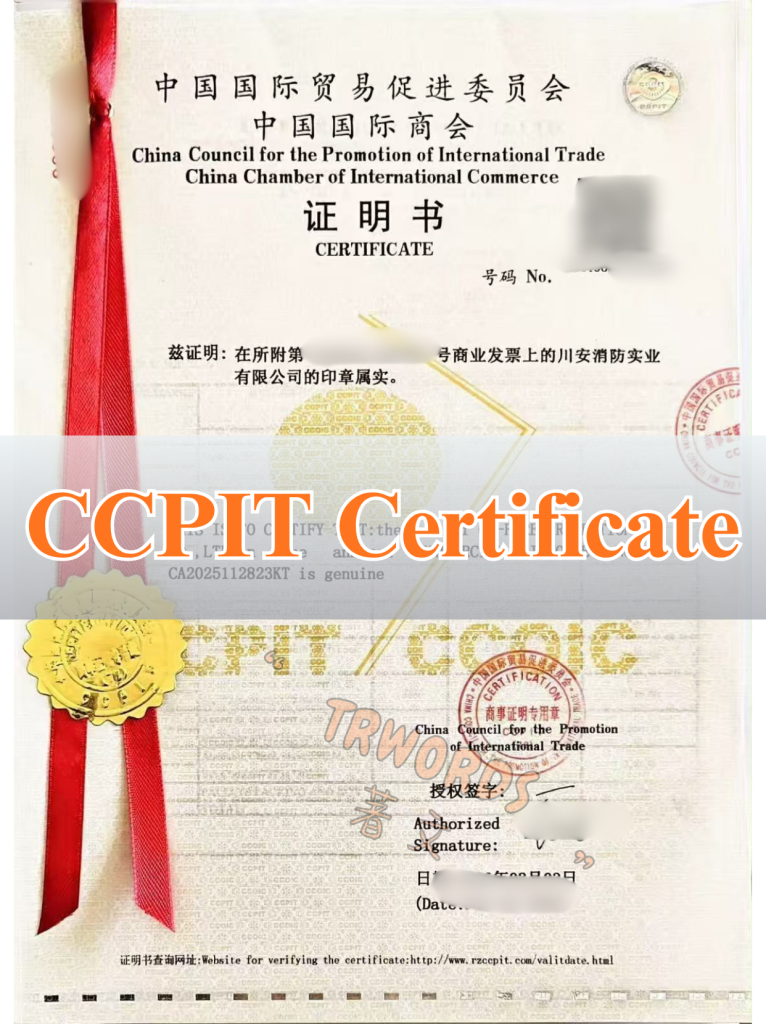
CCPIT stands for the China Council for the Promotion of International Trade. Among its trade-related services, CCPIT issues commercial certificates for documents and facts connected with international commercial activities, as well as Certificates of Origin and other trade documents.
For an overseas importer, CCPIT certification is commonly relevant when a commercial document issued in China needs an additional form of authentication before it can be submitted abroad. The exact requirement may come from the destination country’s customs authority, a bank, a government department, a customer or the importer’s customs broker.
A Commercial Invoice is a typical example because it is issued by the Chinese exporting company. Depending on the destination and transaction, other company-issued or commercial documents such as a Power of Attorney, Packing List, shipping document or inspection-related document may also be submitted for CCPIT commercial certification when required.
A Certificate of Origin Is Different
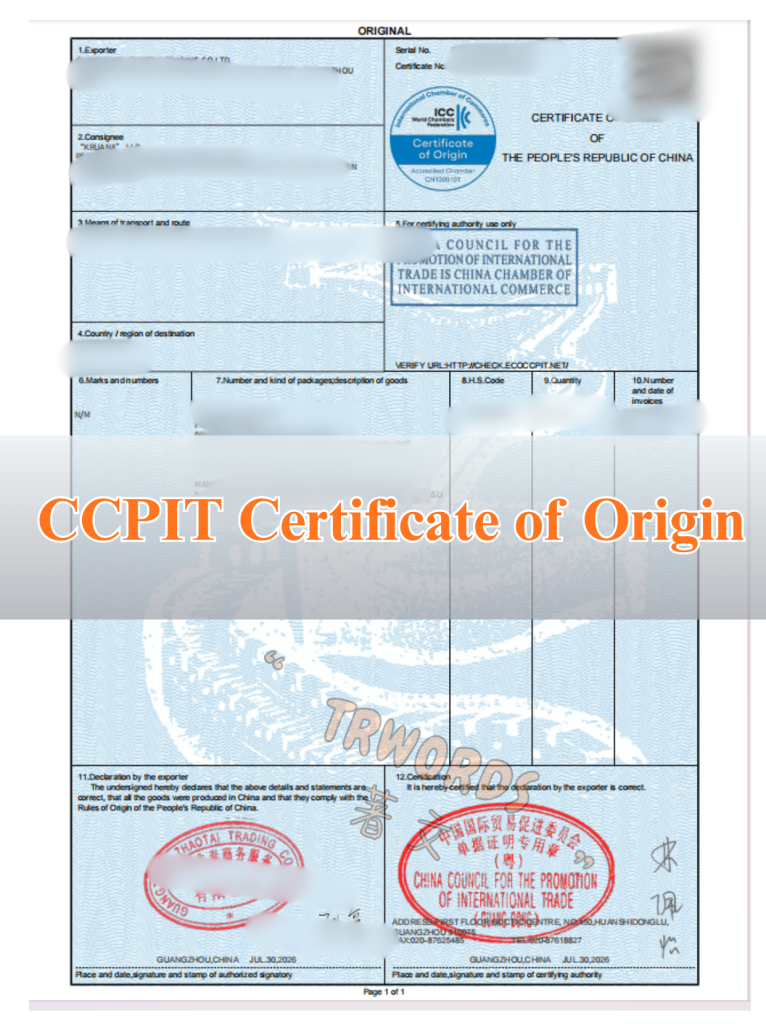
A Certificate of Origin, or CO, may appear alongside the Commercial Invoice and other shipping documents, but its role in the process is different. CCPIT itself is authorised to issue Certificates of Origin through its origin certification system.
Therefore, if you already have a Certificate of Origin issued by CCPIT, you do not send that certificate back to CCPIT for another round of CCPIT commercial certification. The CO is already a CCPIT-issued document.
This is different from a Commercial Invoice, for example. The invoice originates from the exporting company, so where the importing country requires Chamber of Commerce certification, the company document can be submitted to CCPIT for commercial certification.
For an overseas buyer, it is therefore worth checking exactly what your customs broker is requesting. “We need a CCPIT Certificate of Origin” and “we need the Commercial Invoice certified by CCPIT” describe two different requirements.
What If Your Chinese Supplier Does Not Know How to Arrange CCPIT Certification?
This happens quite often in international sourcing. A factory may be perfectly capable of manufacturing and exporting the goods but may have little experience with a particular importing country’s document certification requirements.
We can assist overseas buyers with the CCPIT certification process in China. The Chinese supplier will still need to cooperate because company information and company-issued documents cannot simply be created by ahttp://contact third party.
Depending on the document, we may ask the supplier to complete the required application forms, affix the company’s official seal and provide supporting trade documents. Original signed or stamped materials may also need to be mailed for processing.
This arrangement can be particularly useful when the overseas buyer understands the importing-country requirement but the Chinese supplier does not know how to complete the certification locally. We can communicate with the supplier about the documents needed and assist with the Chinese-side certification procedure.
Does Every Export Document Need CCPIT Certification?
No. A shipment may involve several commercial and customs documents, but they do not automatically follow the same certification route.
Some documents may simply be submitted in their original form. Others may require CCPIT commercial certification, while a Certificate of Origin may be separately issued by CCPIT or another authorised origin-certification body according to the applicable trade arrangement.
Some destination countries accept the original commercial documents without any further authentication, while others may require selected documents to undergo CCPIT certification. If the receiving authority in an Apostille Convention country requires further authentication, a China Apostille can be added to the CCPIT Commercial Certificate or to a Certificate of Origin issued by CCPIT. Saudi Arabia and Türkiye are examples of markets where additional authentication of certain trade documents may arise, although the exact requirement depends on the goods, importer and receiving authority.
For destinations outside the Apostille Convention, selected commercial documents may instead need Chinese diplomatic authentication followed by authentication by the destination country’s embassy or consulate in China.
The UAE, Qatar, Kuwait and Iraq are examples of markets where this may apply to trade documents such as Commercial Invoices, Certificates of Origin, Packing Lists or other shipment-related documents.
Check the Requirement Before Asking Your Supplier to Certify Everything
For overseas buyers, one of the useful first steps is to send the exact document requirement from your customs broker, bank or receiving authority to the Chinese supplier. If the instruction says “Chamber of Commerce certification”, “CCPIT certification”, “Certificate of Origin”, “Apostille” or “embassy legalisation”, these terms should be treated separately.
This avoids unnecessary certification and helps identify the correct route before the supplier starts preparing documents. If your Chinese supplier has the documents but is unfamiliar with CCPIT procedures, we can assist with the China-side application and coordinate the required forms, company seals and original-document mailing.