
A German driving licence may contain several vehicle categories, but the holder does not necessarily need to apply for every corresponding category in China. In one recent case, our client was visiting China and only planned to drive an ordinary passenger car, so the Chinese translation stated “Corresponding Chinese driving category: C1.”
The original German licence contained several driving entitlements, including ordinary cars, trailers and other vehicle categories. The translation still reflected the information shown on the original licence, while the additional C1 notation identified the Chinese category relevant to the client’s actual driving needs.

Why Was C1 Used When the German Licence Had Several Categories?
German and Chinese driving licence categories are organised differently, so the letters shown on a German licence cannot simply be transferred directly into the Chinese system. For a visitor who only intends to drive an ordinary car, there is usually no practical need to pursue Chinese driving privileges for every additional category appearing on the German licence.
In China, C1 covers both manual and automatic small cars, while C2 is limited to automatic small cars. Chinese rules also allow a holder of an overseas licence to apply for a corresponding category or voluntarily apply for a lower category where appropriate.
For this particular client, C1 matched what he actually intended to drive during his stay in China. This is why we normally ask about the intended vehicle type and the city of application before preparing the final translation.
What If You Want to Convert Higher Vehicle Categories?
The situation changes if an overseas licence holder genuinely wants Chinese driving privileges for larger vehicles. Applying for categories such as a large bus, heavy tractor-trailer, city bus, medium-sized bus or large goods vehicle involves considerably more than the usual procedure for an ordinary C1 licence.
Under the current rules, overseas licence holders generally take Subject 1 when applying for a Chinese licence, while applicants for those larger vehicle categories must take Subjects 1, 2 and 3, including practical driving examinations. Applicants seeking certain categories, including large buses, heavy tractor-trailers and medium-sized buses, must also have held the corresponding overseas category for at least two years.
For someone visiting China simply to drive a normal passenger car, those additional procedures may have no practical value. This is why the purpose of the application matters just as much as the complete list of entitlements printed on the foreign licence.
What Is Included in a German Driving Licence Translation?
A complete Chinese translation should cover the information actually appearing on the German licence, including the holder’s personal details, licence number, issuing authority, dates, vehicle categories and relevant conditions. German licences may also contain numerical codes relating to particular restrictions or historical driving entitlements, and these should be reviewed during translation where relevant.
We need clear colour images of the complete licence, including both sides. Much of the category and restriction information appears on the reverse, so sending only the photo side may leave important information missing.
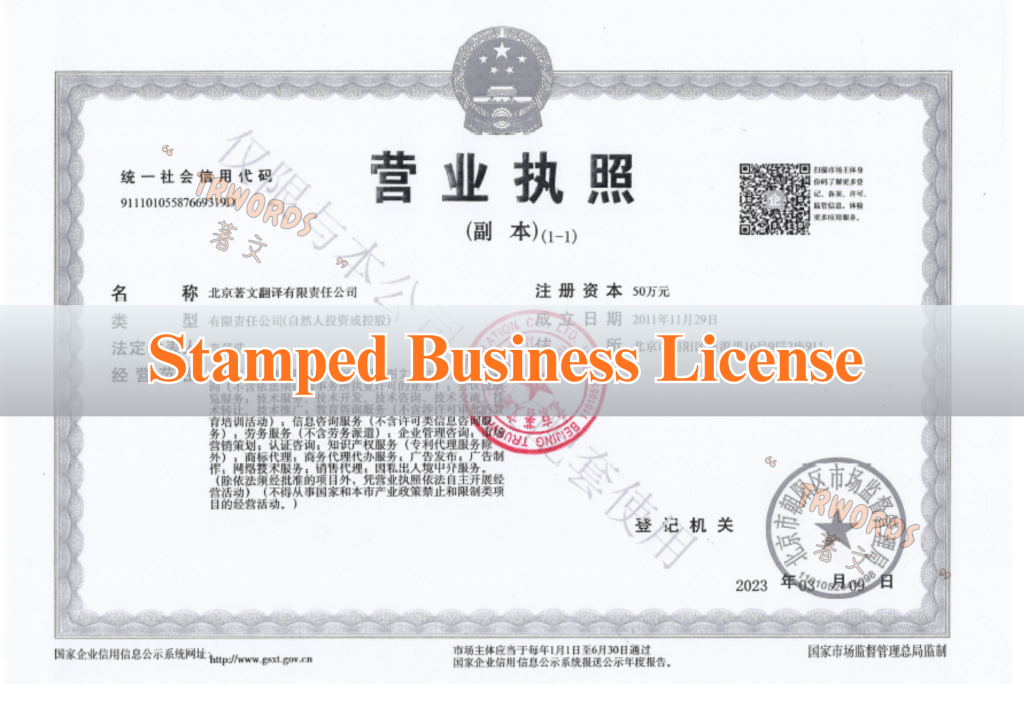
For official submissions in China, the translation is commonly issued by a legally registered translation company and bears the company’s official seal. A copy of the translation company’s Business License, also bearing the company’s official seal, is generally submitted together with the Chinese translation.
Decide on Your Chinese Name Before Applying
Foreign applicants should also think about the Chinese name they will use for the driving licence procedure. If you already have a Chinese name used on previous official records in China, it is better to provide the exact Chinese characters to the translator so that the same version can be used consistently.
If you have never used a Chinese name before, it is worth deciding on one before the translation and application are prepared. This can reduce inconsistencies between the translated licence, application forms and later vehicle administration records.
Translation Requirements Can Differ Between Chinese Cities
The basic national rule is that a foreign-language overseas driving licence must be accompanied by a Chinese translation issued by a translation organisation or notarised by a notary office. Local authorities may have more specific requirements concerning the translation format and supporting documents.
Shanghai requires driving licence translations to be issued by certain accepted translation agencies. We work with a cooperating translation provider that can prepare translations for applications in Shanghai.
Guangzhou has a different local requirement: the translation needs to bear the official seal of a Guangzhou-based translation company. For this reason, applicants should tell us where they plan to apply before the translation is prepared, so the documents can be arranged according to the local requirement.