
For foreigners who have lived in China for several years, renewing a passport is completely normal. The difficulty sometimes appears later, when a Chinese notary office needs to review documents issued under an old passport number while the applicant now holds a different passport.
This can affect notarization of police clearance records, academic documents, employment-related records, declarations and other documents connected with an earlier period in China. Even when the name, date of birth and nationality remain unchanged, the notary office may still ask for evidence linking the two passport numbers.
Some Passports Make the Link Easy
The situation is straightforward when the new passport itself refers to the previous passport number. We have seen passports from countries such as Ecuador where information about an earlier passport is recorded in the new passport.
In that situation, the identity chain can often be seen directly from the passport. The notary office can compare the current passport with the historical documents and see why an old passport number appears in earlier Chinese records.
Other countries issue a replacement passport without showing the previous passport number. This creates an extra step because the new passport itself does not explain the relationship between the two documents.
“My Name and Date of Birth Are the Same. Isn’t That Enough?”
This is one of the questions foreign applicants often ask. From the applicant’s perspective, matching names, dates of birth and other personal details may seem sufficient to show that both passports belong to the same person.
A Chinese notary office may still require documentary evidence establishing the connection between the old and new passport numbers. The reason is practical: the notary needs an evidence chain supporting the identity used in the notarization, particularly when earlier Chinese records were created under a passport that has already expired.
The exact supporting document accepted can vary between notary offices and individual cases. An official record or letter from the passport-issuing authority is one possible solution when the current passport does not contain the previous passport number.
A British Client Who Needed to Link Two Passport Numbers
One of our British clients encountered exactly this issue. Her old and new passports showed the same name, date of birth and place of birth, but the new British passport did not contain the number of his previous passport.
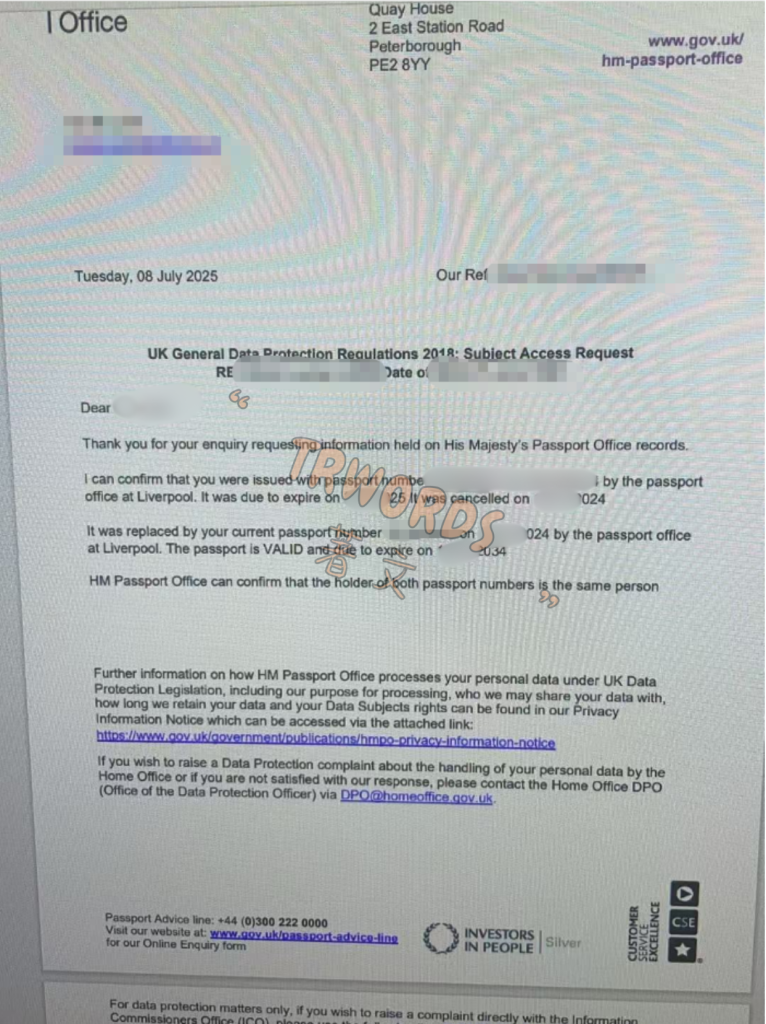
The notary office therefore asked for further evidence connecting the two passports. The client contacted the relevant UK passport authority and requested confirmation of his passport history.
Around two weeks later, she received an official reply. The letter set out the old passport number, its date of issue and expiry date, together with the new passport number and date of issue.
Those details created a clear documentary link between the expired passport and the current one. The letter was then accepted by a Chinese notary office as supporting evidence for the notarization.
This is a useful example for British nationals who have spent many years in China and renewed their passports during that period. If older Chinese documents show a passport number that no longer appears anywhere on the current passport, obtaining an official passport-history confirmation may save considerable uncertainty during the notarization process.
Why Does the Final Notarial Certificate Only Show My New Passport Number?
Another question sometimes comes up after the notarization has been completed. An applicant may have provided both an old and a new passport during the review process, yet the final notarial certificate only identifies them using the current passport.
That is generally normal. The current valid passport is used as the applicant’s present identity document, while the expired passport and the evidence linking the two passport numbers serve as supporting materials during the notary office’s review.
An expired passport does not need to appear in the final notarial wording simply because it formed part of the evidence file. Its purpose may simply be to connect historical records with the applicant’s current identity.
Keep Your Old Passport Records
For foreigners who expect to use Chinese documents internationally in the future, it is worth keeping copies of expired passports, previous residence permits and other records showing earlier passport numbers. These documents can become important years later when applying for a Chinese police clearance, notarization or another official procedure.
If your country records the previous passport number in your new passport, the process may be relatively simple. If it does not, check early whether an official passport-history letter, passport record or similar document can be obtained from the issuing authority.
A passport renewal itself is rarely the difficult part. The important issue for later notarization is being able to show a clear connection between the identity used in your older Chinese records and the valid passport you hold today.