
When a U.S. individual, corporation, LLC, or other organization participates in litigation in China, the court will usually require a set of documents establishing the party’s identity, legal status, and authority to act. In practice, many parties already hold corporate formation records, certificates of status, board resolutions, or powers of attorney, yet still encounter supplemental document requests once the filing stage begins.
The issue is often not whether documents exist, but whether they connect in a way that clearly explains the full chain of authority. The court typically wants to see several points established in sequence: whether the company is legally existing and in good standing, who has authority to sign on its behalf, and how that signer validly authorizes Chinese counsel or another litigation representative. If any part of that chain is incomplete, the document package may be viewed as insufficient.
For U.S. parties preparing to sue, defend, or otherwise appear in proceedings in China, this is a recurring procedural issue. It is particularly relevant in cross-border commercial disputes and intellectual property litigation, where Chinese courts often examine foreign party qualification documents closely. This article explains how proof of legal status for litigation in China is typically structured for U.S. individuals and U.S. companies, and why document preparation should be approached state by state rather than through a single generic template.
What Are “Proof of Legal Status” Documents in Chinese Litigation?
In the context of litigation in China, “proof of legal status” generally refers to the set of documents used to establish a party’s identity, legal existence, status, and authority.
For a U.S. individual, the required materials usually focus on personal identification and authorization documents.
For a U.S. corporation, LLC, or other organization, the document set usually includes three layers of proof:
- evidence that the entity lawfully exists and remains active;
- evidence showing who has authority to sign on behalf of the entity; and
- authorization documents appointing Chinese counsel or another representative for the litigation.
These materials are rarely evaluated in isolation. Chinese courts generally review them as a connected package. A certificate showing that a company exists does not, by itself, prove who may sign a power of attorney. A signed authorization document, standing alone, may not be enough unless the signer’s authority can also be traced to corporate records or government filings.
What Documents Does a U.S. Individual Usually Need for Litigation in China?
For a U.S. natural person, the document package is usually more straightforward. The focus is typically on identity and authorization.
Identification Documents
A valid passport is the most common identification document.
Depending on the nature of the case, additional supporting documents may also be relevant. For example, disputes involving inheritance, marriage, or family relationships may require supplemental civil status records or related evidence.
Power of Attorney or Authorization Document
If the individual appoints Chinese counsel or another litigation representative, a power of attorney is usually required.
The authorization document should identify the appointed representative and clearly describe the scope of authority. The clearer the authority language, the easier the document is to use in court practice.
Apostille or Other Formalities
For U.S. individual documents intended for use in Chinese litigation, the Apostille route is now generally the relevant authentication path. Once the document is prepared, notarization may be required depending on the document type, followed by an Apostille issued by the competent authority in the relevant U.S. state.
For individuals, the main difficulty is usually not the number of documents, but whether the intended use is clearly reflected, whether the signature formalities are handled correctly, and whether the scope of authorization is stated with sufficient precision.
What Documents Does a U.S. Company Usually Need for Litigation in China?
For a U.S. company or other organization, proof of legal status for a China lawsuit is usually more complex. In practice, the required materials often fall into three categories.
- Evidence of Corporate Existence or Good Standing
These documents are used to show that the company is legally formed and remains active.
The most common document is a certificate of good standing, certificate of status, or similar official record. The exact title varies by state, but the function is broadly the same: it shows that the company is currently in existence and has an active legal status under the law of its state of formation.
- Evidence of Signing Authority
A good standing document only addresses one issue: whether the company exists. It usually does not establish who may sign litigation documents on the company’s behalf.
To prove signing authority, companies often need additional materials, such as:
- annual reports;
- articles of incorporation or certificates of formation;
- amended or restated charter documents;
- bylaws or operating agreements;
- board resolutions;
- shareholder resolutions;
- state filing records;
- official records identifying directors, officers, managers, or managing members; and
- authorization documents or legal representative statements bearing the company seal, where applicable.
The importance of each document varies by state and by entity type.
- Authorization Documents for the China Litigation
Once the signer’s authority is established, the next step is usually to prepare the litigation authorization documents themselves.
These often include a power of attorney and, in some cases, a statement identifying the authorized representative. Their purpose is to make clear who is being appointed, what powers are granted, and whether the appointed person may sign or act in connection with litigation in China.
Within the full document package, these authorization papers serve as the final link between internal corporate authority and the actual litigation representative before the Chinese court.
How These Three Layers Must Work Together
A common reason U.S. parties receive document deficiency notices is that the materials do not connect cleanly across the three key layers.
The first layer is legal existence: the company must be shown to exist and remain in valid status.
The second layer is signing authority: the document package must show why the person who signed has authority to bind the company.
The third layer is litigation authorization: the package must then show how that signer validly authorizes Chinese counsel or another litigation agent.
If any part of this sequence is missing, the overall package may appear incomplete. Common examples include:
- a certificate of good standing without any supporting proof of who may sign for the company;
- a board resolution that names a position but is not clearly tied to the signer’s identity in official records;
- a signed power of attorney without the underlying corporate documents needed to support the signer’s authority.
In practice, this is why document preparation for cross-border litigation in China often involves more than simply collecting corporate records. The logic of the package matters as much as the documents themselves.
Why U.S. Company Documents Cannot Be Prepared from a Single National Template
One reason these filings can become difficult is that U.S. corporate documentation is state-specific. Even where two states issue similar corporate status certificates, the naming conventions, filing practices, and supporting documents used to prove signing authority may differ.
For that reason, the company’s state of formation should usually be confirmed at the outset. Once the state is identified, it becomes easier to determine which filings, corporate records, and authority documents are most likely to be accepted and how they should be assembled.
Below is a practical overview of several states that often arise in China-related litigation matters.
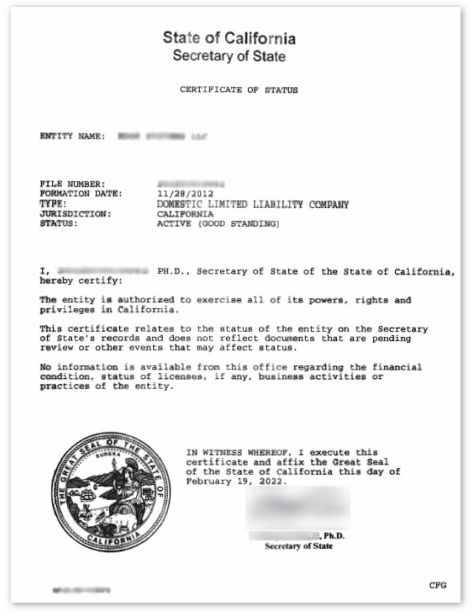
California: Statements of Information, Restated Charter Documents, and Board Resolutions Often Matter
For California entities, a certificate issued through the Secretary of State typically serves as the baseline document for corporate existence or active status. However, that certificate usually does not identify who has authority to sign on behalf of the company.
To bridge that gap, parties often rely on supporting documents such as:
- statements of information;
- restated articles or other charter documents;
- board resolutions;
- representative identity or authorization statements;
- powers of attorney;
- documents bearing a properly recorded corporate seal, where relevant; and
- attachments or related content associated with official filings such as SI-550.
In California matters, it is often helpful to treat proof of existence and proof of signing authority as two separate issues and organize the documents accordingly.
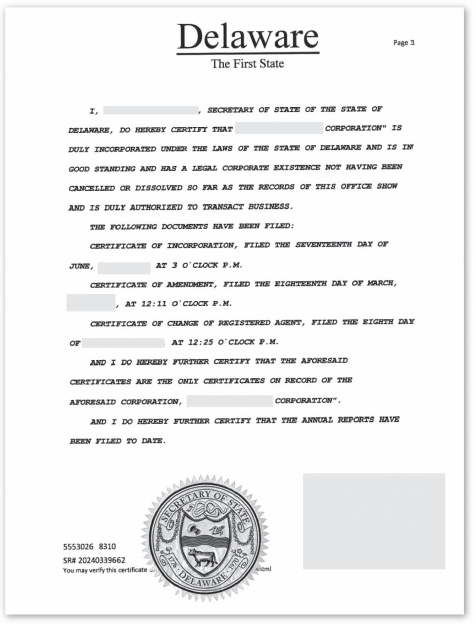
Delaware: Annual Reports, Charter Documents, and Board Resolutions Are Frequently Used Together
Delaware entities appear frequently in China litigation, especially in commercial and intellectual property disputes.
A Delaware certificate of good standing is usually the starting point, but it is only the starting point. To establish signing authority, parties often need to work from a combination of documents, including:
- annual franchise tax reports;
- certificates of incorporation or other charter documents;
- board resolutions;
- amended or restated formation documents; and
- authorization documents bearing a properly recorded corporate seal, where applicable.
For Delaware entities, the document package is often strongest when the proof of good standing is paired with records that clearly identify the signer’s role and authority within the company.
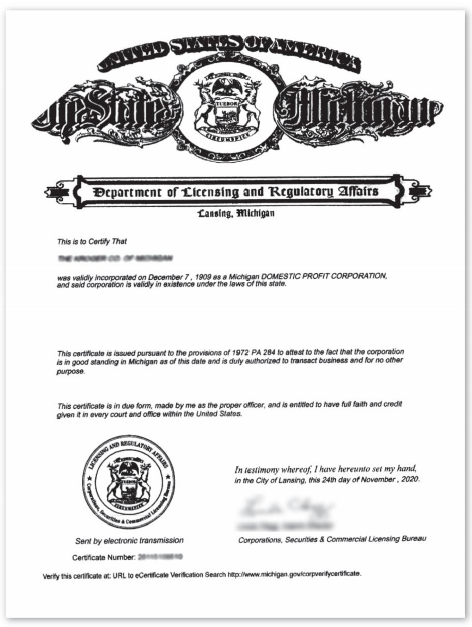
Michigan: Annual Reports, Bylaws, Board Resolutions, and Regulatory Filings May All Be Relevant
For Michigan companies, good standing remains a core document, but it is often not enough by itself.
To establish who may sign for the company, parties may also need annual report information filed with the relevant state authority, board resolutions, bylaws, or other corporate records. In some cases, substitute materials may also be considered, such as an authorization document bearing a properly registered company seal, confirmed by a notary, or records filed in another U.S. jurisdiction that help establish the signer’s role. In some circumstances, local statutory provisions expressly defining officer or manager authority may also be relevant.
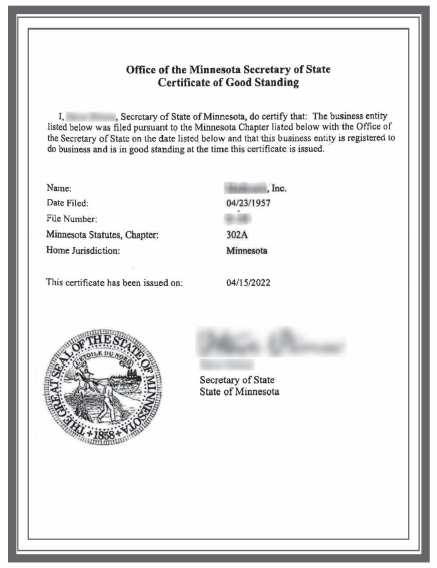
Minnesota: Annual Reports Often Play a More Central Role
Minnesota filings can present a somewhat different emphasis. Annual reports may play a more significant role in showing who is authorized to sign, particularly where the signer is the CEO or another senior officer.
In addition, officially filed representative statements or internal authorization materials may be used to connect the signer’s corporate position to the authority exercised in the China litigation documents.
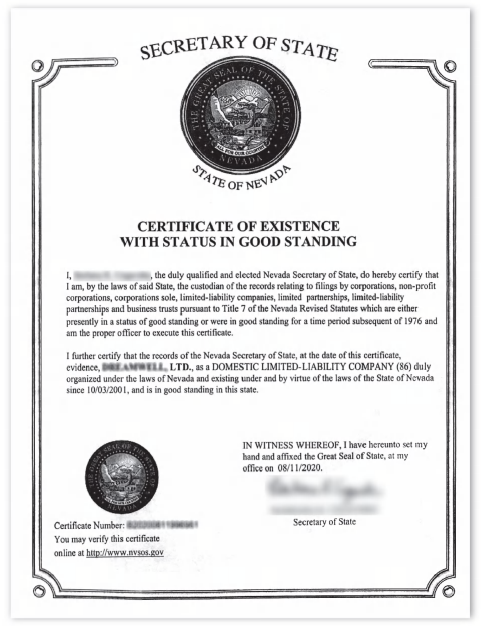
Nevada: Manager Lists and Operating Agreements Can Be Important
For Nevada entities, signing authority is often shown through a combination of board resolutions and charter or organizational documents.
If a standard board resolution is unavailable, a resolution signed by all directors may in some cases be used to support authority. In addition, lists identifying managers or authorized signers, as well as amended or restated formation records certified through the Secretary of State, may serve as useful evidence of authority.
For Nevada LLCs in particular, operating agreements and manager identification records may be especially important.
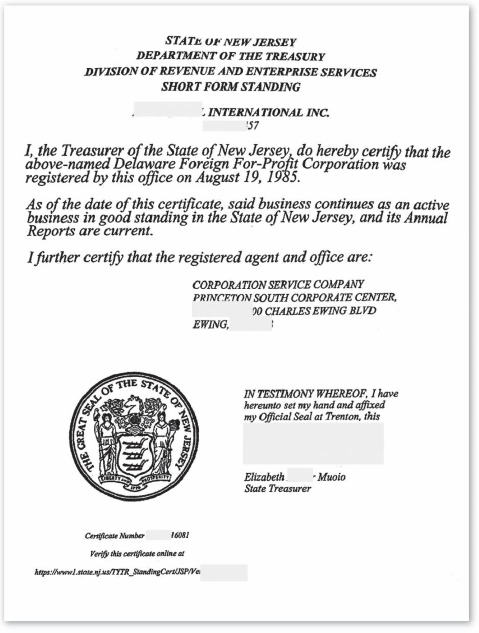
New Jersey: There May Be More Flexibility in the Types of Documents Used to Prove Authority
For New Jersey companies, corporate status documents are typically issued through the Department of the Treasury or related business records office. To prove authority, parties may rely on a broader range of materials, including:
- filed records concerning the specific signer;
- board resolutions;
- shareholder resolutions;
- business registry extracts;
- charter documents;
- powers of attorney bearing a properly recorded company seal, where supported by notarial confirmation; and
- statutory provisions establishing the authority of officers, managers, directors, or similar roles.
Common supporting materials may also include annual reports, officially filed charter documents, or state records from other jurisdictions that expressly identify the signer’s corporate position.
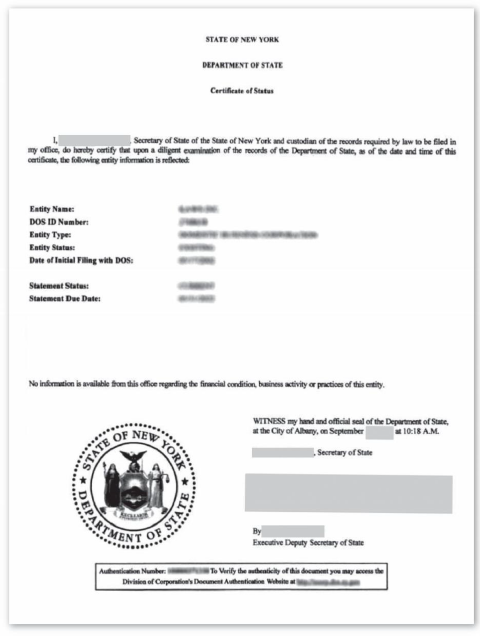
New York: Corporate Status and Signing Authority Often Need to Be Shown Separately
For New York companies, proof of corporate existence is often obtained through the Department of State. In some cases, annual reports or SEC filings may also have practical relevance, particularly for public companies.
Proof of signing authority often requires a separate step. Depending on the facts, relevant materials may include:
- state filing records in other jurisdictions showing the signer’s authority;
- authorization statements or powers of attorney bearing a properly recorded corporate seal, where that seal can be authenticated;
- filed bylaws;
- board resolutions;
- shareholder resolutions; or
- business registry records identifying the individual authorized to act for the company.
Once signing authority has been established, the final authorization documents can then be used to identify the appointed litigation representative and define the scope of authority for the China proceeding.
How U.S. Documents Are Commonly Authenticated for Use in Chinese Litigation
Because the United States is a member of the Apostille Convention, U.S. documents intended for use in litigation in China now generally follow the Apostille path rather than the older consular legalization route.
In broad terms, the process usually works as follows:
- prepare the required documents;
- arrange notarization where the document type requires it;
- obtain an Apostille from the competent authority in the relevant U.S. state; and
- arrange Chinese translation and document organization for court submission in China.
For many U.S. litigants, this is one of the most important procedural changes to understand. A document may be perfectly valid in the United States, but still unusable in Chinese litigation unless the authentication and translation steps are completed in the form expected by the court.
Common Reasons U.S. Parties Are Asked to Supplement Their Documents
In practice, requests for supplemental materials often arise for a few recurring reasons.
Only the Good Standing Document Was Prepared
A certificate of good standing shows that the company exists. It usually does not show who has authority to sign a power of attorney or litigation filing.
The Signer’s Identity Does Not Match the Authority Chain
The court may ask how the signer’s position is proven, what document grants that authority, and how that authority supports the appointment of Chinese counsel.
The State of Formation Was Not Confirmed Early
Using a generic template without confirming the company’s state of formation can lead to a mismatch between the actual filing system and the documents submitted.
The Corporate Records Do Not Align with Each Other
Bylaws, annual reports, board resolutions, and government filings may each appear valid on their own, yet still fail to form a consistent authority narrative when reviewed together.
Individual and Company Documents Were Mixed Together
In some cases, both an individual and a company are involved. When multiple parties are submitting different categories of documents, careful separation and labeling become even more important.
Practical Questions to Confirm Before Starting
Before formally preparing proof of legal status for litigation in China, it is often useful to confirm the following points:
- Is the party a U.S. individual or a U.S. company?
- If it is a company, what is the state of formation?
- What documents are already available?
- Is a current certificate of good standing already in hand?
- Will additional proof of signing authority be needed?
- Has the power of attorney already been prepared?
- Which documents need notarization before Apostille?
- Has the Apostille process already been started?
- Have the Chinese translation and court submission requirements been confirmed?
These questions often help identify missing links before the documents reach the court.
Final Thoughts
For U.S. parties involved in litigation in China, proof of legal status is usually not a single document. It is a coordinated set of materials that should establish identity, legal existence, signing authority, and litigation authorization in a clear sequence.
For U.S. individuals, the issues are often relatively focused: identity documents, powers of attorney, and Apostille formalities. For U.S. companies, the analysis is typically more layered. Good standing documents, authority records, and authorization papers each serve a distinct purpose and usually need to work together.
State-specific differences also matter. California, Delaware, Michigan, Minnesota, Nevada, New Jersey, and New York each present their own filing patterns, document labels, and authority structures. For that reason, companies preparing for litigation in China are often better served by analyzing their state records first, then building a document package that reflects the actual corporate chain of authority rather than relying on a one-size-fits-all template.
Disclaimer: This article is provided for general informational purposes only and does not constitute legal advice, a legal opinion, or a formal legal service recommendation of any kind. Document requirements may vary depending on the facts of a particular case, the court involved, the type of document, the method of execution, and the applicable authentication procedure. Any party preparing documents for use in litigation in China should verify the current requirements based on the specific case and the latest guidance from the relevant court, qualified PRC counsel, or other competent authorities. Before taking legal action or preparing cross-border litigation documents, parties are encouraged to seek advice from qualified legal professionals based on their particular circumstances.