
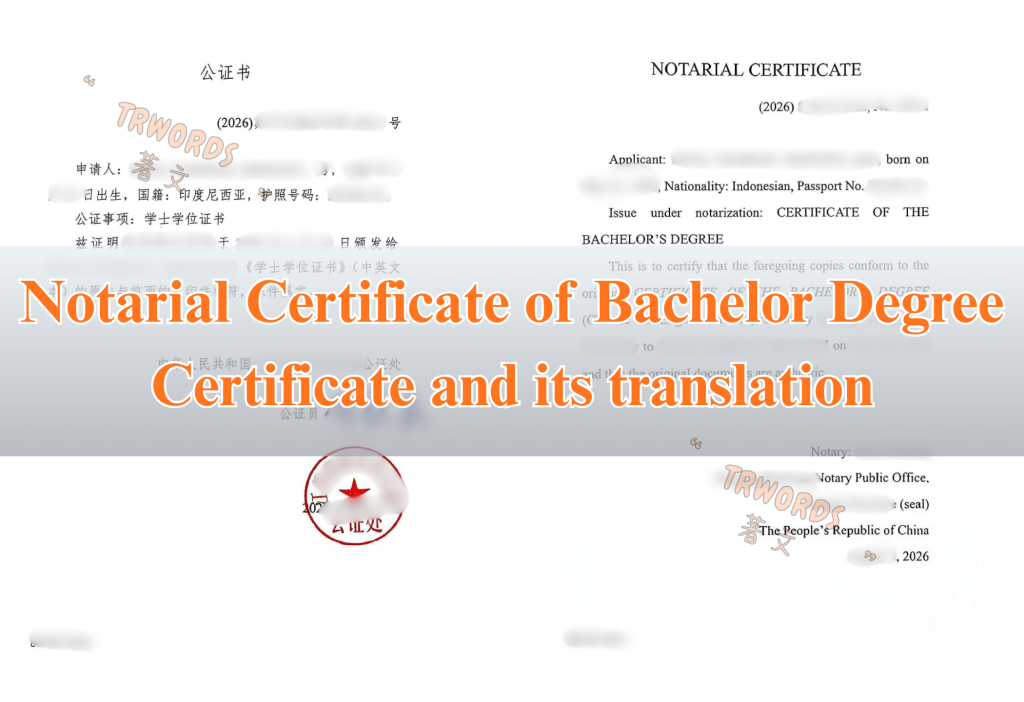
An Indonesian student who had studied at a university in China recently needed three academic documents prepared for further study in Australia: his Graduation Certificate, Degree Certificate and Academic Transcript. The documents were notarised in China and, for this application, the process stopped there — no China Apostille was required.
This is more common than many applicants expect. In our handling experience, Chinese notarial certificates are often accepted directly for academic and similar purposes in destinations including, but not limited to, Australia, Japan, New Zealand, Canada, the United States, the United Kingdom and Singapore, without further authentication.
Australia Is an Apostille Country — So Why Was No Apostille Needed?
Australia is a party to the Apostille Convention, as is China. That fact alone, however, does not mean that every Chinese document submitted in Australia must carry an Apostille.
The HCCH itself makes this distinction clear: an Apostille is needed only when the destination country or receiving authority requires one in order to recognise the foreign public document. The Convention does not itself impose an Apostille requirement on every document moving between two Contracting Parties.
For this Indonesian graduate, the Australian receiving institution accepted the Chinese academic notarial certificates without further authentication. The document route was therefore simply:
Chinese academic documents → Chinese notarisation → submission in Australia
Adding an Apostille would have meant extra processing time and cost without serving a purpose for this particular application.
Notarisation May Already Be the Final Step
When preparing Chinese academic documents for overseas use, applicants often assume there is a fixed sequence: notarisation first, Apostille second. In practice, the correct stopping point depends on what the university, employer, professional body or government authority actually asks for.
For academic applications, a Chinese notarial certificate is often already a well-structured document for overseas review. It normally provides the notarial certification together with the relevant document contents and translation, allowing the receiving institution to assess the qualification without asking for another layer of authentication.
This is why we generally recommend checking the receiving institution’s wording before arranging an Apostille. If the requirement only asks for a notarised document, Chinese notarial certificate, certified academic document or notarised translation, there may be no reason to proceed further.
Australia Is Only One Example
We encounter the same situation with Chinese documents submitted to institutions in Japan, New Zealand, Canada, the United States, the United Kingdom and Singapore, among other destinations. For many academic and similar applications, the Chinese notarial certificate can be submitted directly.
These countries should not be treated as a blanket “no Apostille required” list. A university may accept a Chinese notarial certificate on its own, while a government authority in the same country may require an Apostille for a different document or procedure.
The intended use therefore matters just as much as the destination country. The safest approach is to confirm the requirement with the actual receiving institution before deciding whether the Chinese notarial certificate needs any further authentication.
Do Not Add an Apostille Automatically
The Apostille Convention is designed to simplify authentication when authentication is required. It does not create an obligation to authenticate documents that the receiving authority is already prepared to accept.
That distinction can save international students unnecessary time and expense. If a university in Australia accepts the Chinese notarial certificate directly, there is little value in adding an Apostille simply because Australia appears on the list of Apostille Convention countries.