
If you are preparing documents for use in Australia, you may have been told that your Chinese documents must be translated by a NAATI Certified Translator.
Whether you are applying for a visa, permanent residence, Australian citizenship, university admission, professional registration, or a skills assessment, the receiving authority in Australia may require English translations that comply with Australian requirements.
Many applicants, however, are unsure what a NAATI-certified translation actually is, which documents require one, how to verify the translator’s credentials, or whether a standard translation will be accepted.
This guide explains the essentials of NAATI-Certified Chinese to English Translation and what you should know before submitting your documents.
What Is a NAATI-Certified Chinese to English Translation?
NAATI stands for the National Accreditation Authority for Translators and Interpreters, Australia’s national standards and certification authority for translators and interpreters.
A NAATI Certified Translator is a translator who has met NAATI’s certification requirements and is authorized to produce certified translations that are accepted by many Australian government departments, universities, licensing authorities, and professional organizations.
One important point often causes confusion.
A NAATI-certified Chinese to English translation does not certify that your Chinese document is genuine or legally valid. Instead, it certifies that the translation has been completed by a translator holding an appropriate NAATI certification and that the English translation faithfully represents the source document.
Why Might You Need a NAATI-Certified Chinese to English Translation?
If your original documents are written in Chinese, many Australian organizations require an English translation before they can assess your application.
Common situations include:
- Australian visa applications
- Permanent residency applications
- Australian citizenship applications
- Skills assessments
- AHPRA registration
- Engineers Australia assessments
- CPA Australia applications
- University admissions
- Employment applications
- Driver license conversion
- Court proceedings
- Banking, insurance, and other official matters
Many Australian authorities specify that documents not written in English should be translated by a NAATI Certified Translator or another translator meeting their published requirements.
Because individual agencies may have different policies, applicants should always check the latest document requirements issued by the receiving authority.
Which Chinese Documents Can Be Translated?
NAATI-certified translations are commonly prepared for a wide variety of personal, academic, commercial, and legal documents.
Identity Documents
- Chinese Passport
- Chinese Identity Card
- Household Register
Civil Status Documents
- Birth Certificate
- Marriage Certificate
- Divorce Certificate
- Death Certificate
Academic Documents
- Graduation Certificate
- Degree Certificate
- Academic Transcript
- Diploma Supplement
- Enrollment Certificate
Employment Documents
- Employment Certificate
- Employment Contract
- Income Certificate
- Social Insurance Records
- Payslips
Financial Documents
- Bank Statements
- Tax Records
- Property Ownership Certificates
- Business Registration Documents
Legal Documents
- Police Clearance Certificate
- Court Judgments
- Powers of Attorney
- Contracts and Agreements
The list is far from exhaustive. If a Chinese-language document must be submitted to an Australian authority, an English translation may be required.
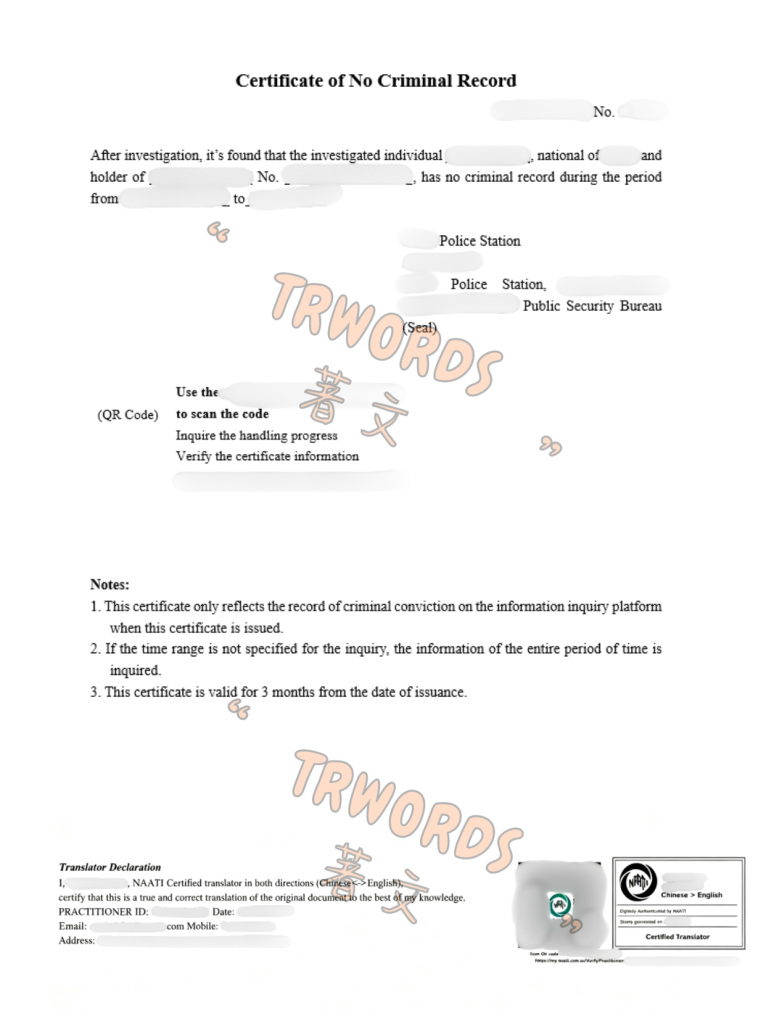
What Does a NAATI-Certified Chinese to English Translation Look Like?
Applicants often wonder whether there is a standard NAATI translation template.
Although certified translators may use slightly different layouts, a typical NAATI-certified translation usually includes:
- the translated document;
- the translator’s declaration;
- the translator’s full name;
- the translator’s NAATI Practitioner ID (CPN);
- the date of certification;
- contact details for the translator;
- QR code.
Some translators also use a professional stamp, although the appearance may vary from one translator to another.
The exact format is less important than ensuring that the translation contains the required certification details identifying the certified translator.
How Can You Verify a NAATI-Certified Translator?
If you receive a certified translation, you may wish to confirm that the translator is currently certified.
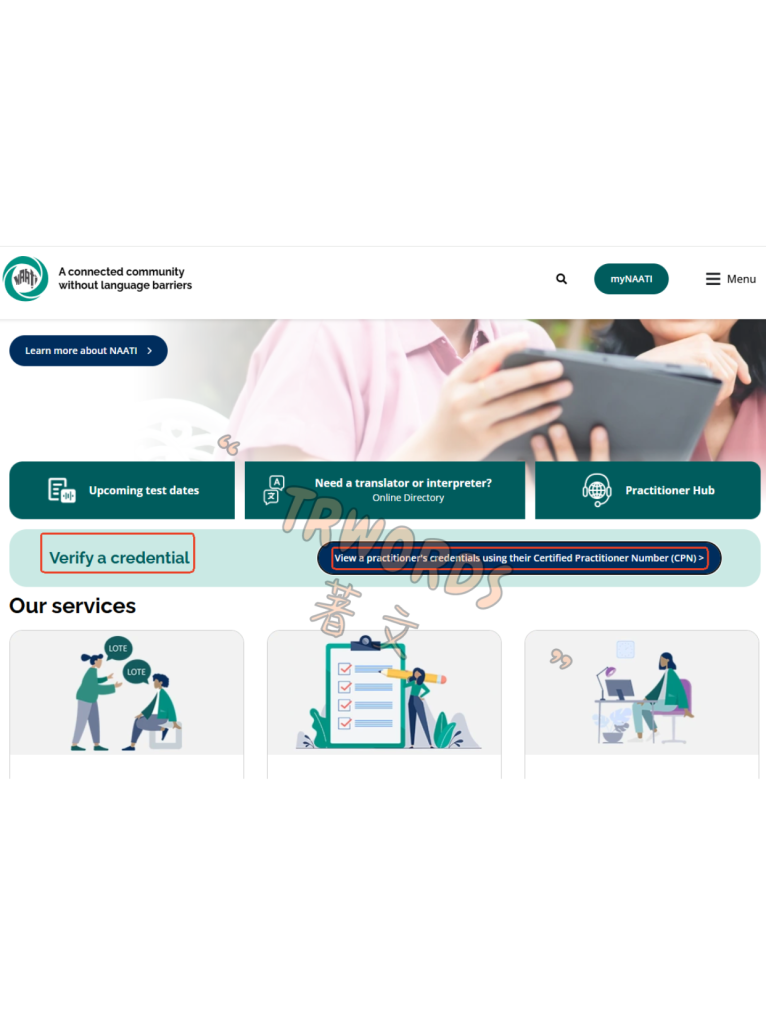
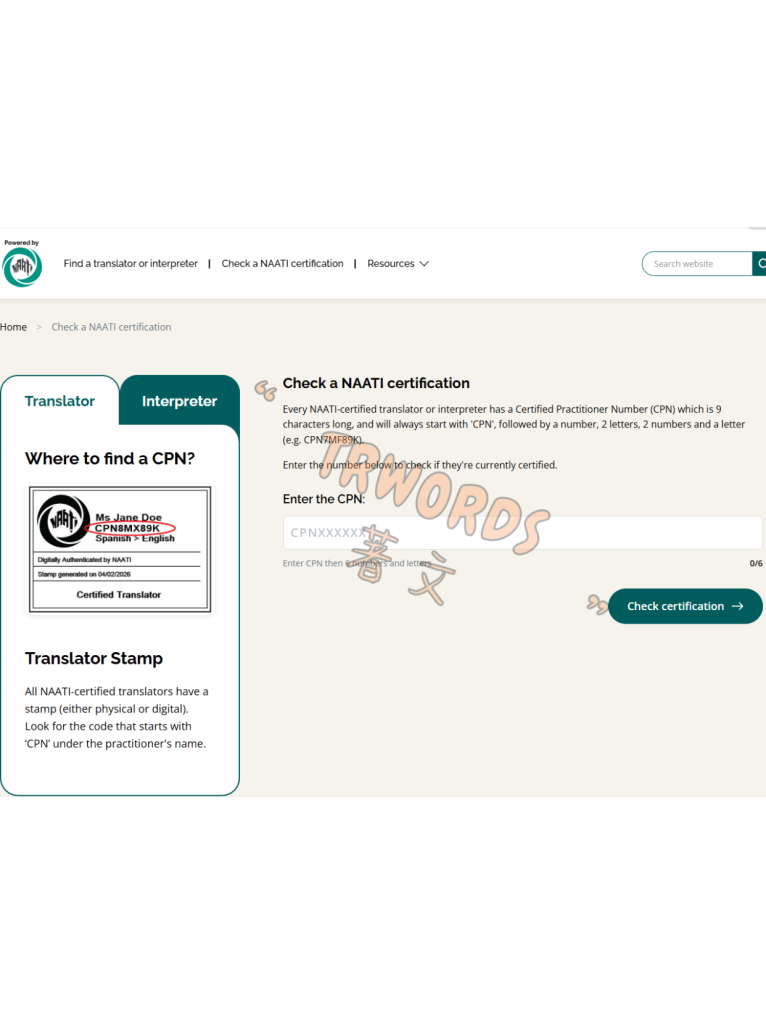
This can usually be done through the NAATI Online Directory, or scanning the QR Code on the translation document to visit the NAATI official website for verification.
You can search using the NAATI Practitioner ID (CPN) shown on the translation.
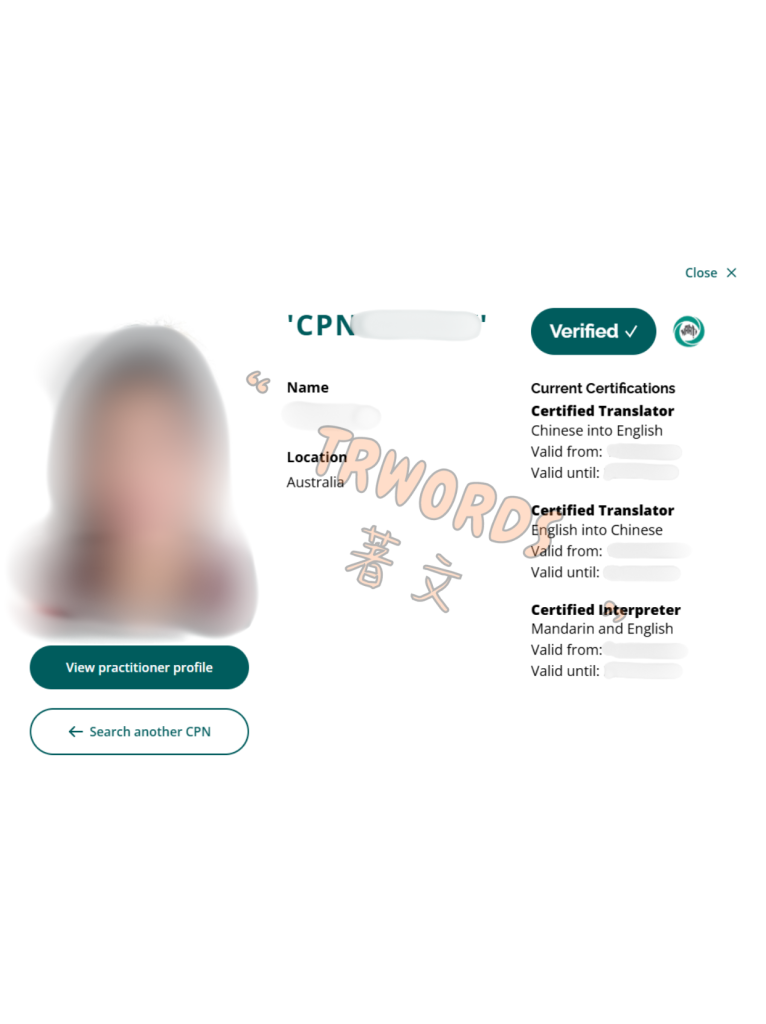
The directory allows users to confirm information such as:
- certification type;
- language pairs (C-E or E-C);
- certification status;
- expiry date of the current certification.
Checking the translator’s details is a simple way to confirm that the translation was prepared by a translator holding an appropriate NAATI certification at the time of issue.
Does a NAATI-Certified Chinese to English Translation Expire?
This is one of the questions applicants ask most frequently.
Generally speaking, a NAATI-certified Chinese to English translation itself does not have a fixed expiry date.
However, the receiving authority may require:
- recently issued source documents;
- recently issued police clearance certificates;
- current financial records;
- updated employment documents.
Some organizations may also request a recently certified translation if the underlying document has been updated.
For this reason, applicants should always review the latest requirements published by the receiving authority rather than relying on a previous application.
NAATI-Certified Translation vs Chinese Notarized Translation
These two services are often confused, but they serve different purposes.
| NAATI-Certified Translation | Chinese Notarized Translation |
| Prepared by a NAATI Certified Translator | Issued by a Chinese notary office |
| Primarily intended for use in Australia | Commonly used for international legal or administrative purposes |
| Certifies the translation | Produces a notarial certificate in accordance with Chinese notarial procedures |
| Frequently accepted by Australian authorities | Used where notarization is specifically required by the receiving authority |
Some applications require only a NAATI-certified translation, while others may also require notarization or additional authentication of original documents. The exact requirements depend on the authority receiving the documents.
How We Can Assist
We assist overseas Chinese, expatriates, and international applicants who need NAATI-Certified Chinese to English Translation for use in Australia.
Commonly translated documents include identity documents, birth and marriage certificates, police clearance certificates, academic records, employment documents, household registers, bank statements, business documents, and court papers.
Our support may include reviewing the receiving authority’s translation requirements, arranging translation by an appropriate NAATI Certified Translator, and providing electronic copies suitable for online submission where accepted.
Before Ordering a NAATI-Certified Chinese to English Translation
Before arranging a translation, it is worth confirming a few practical details:
- Which Australian authority will receive the documents?
- Does it specifically require a NAATI-certified translation?
- Are all pages required, or only selected pages?
- Has the original Chinese document expired or been updated?
Clarifying these questions in advance can help reduce delays and ensure that the translated documents meet the receiving authority’s requirements the first time.