
What Is a Sworn Translation in France?
A sworn translation, known in French as a traduction assermentée, is prepared and certified by a translator registered as a judicial expert with a French Court of Appeal. The translator accepts professional responsibility for the accuracy and completeness of the translation and certifies it with an official statement, signature and stamp.
French authorities commonly use sworn translations when an official document is written in a foreign language. The translation allows an administration, court, university, notary, employer or other receiving body to review the document in French while identifying the translator responsible for the work.
French Court of Appeal expert lists place translators and interpreters under the “Interprétariat – Traduction” category. The French Court of Cassation provides access to the relevant Court of Appeal lists so that users can check a translator’s registration.
When Do Chinese Documents Need a Sworn French Translation?
A sworn French translation is commonly required when a Chinese-language document is submitted to a French public authority, court, university, notary, employer, bank or other institution. The receiving body needs a reliable French version of the document and must be able to identify the translator who certified it.
Common situations include visa and residence applications, marriage and family procedures, nationality matters, university admission, recognition of qualifications, driving licence applications, court proceedings and company-related formalities. The exact requirement depends on the French authority receiving the document, so applicants should check whether a sworn translation is required before placing an order.
What Chinese Documents Can Be Sworn-Translated into French?
Civil Status and Family Documents
- birth certificates
- marriage certificates
- divorce certificates, divorce agreements and court judgments
- household registers and household registration records
- identity cards and passports
- police clearance certificates
- family relationship certificates
- name change and other civil status documents
Driving and Traffic Documents
- driving licences
- safe driving records
Academic and Educational Documents
- high school graduation certificates
- university graduation certificates
- degree certificates
- academic transcripts
- high school examination results
- university entrance examination results
- enrolment certificates
- course descriptions and syllabuses
- professional qualification certificates
Legal and Corporate Documents
- powers of attorney
- declarations and certificates
- contracts and agreements
- court judgments and decisions
- business licences
- articles of association
- board and shareholder resolutions
- company registration documents
Financial Documents
- bank statements
- income certificates
- invoices and payment records
- audit and accounting documents
What Does a French Sworn Translation Look Like?
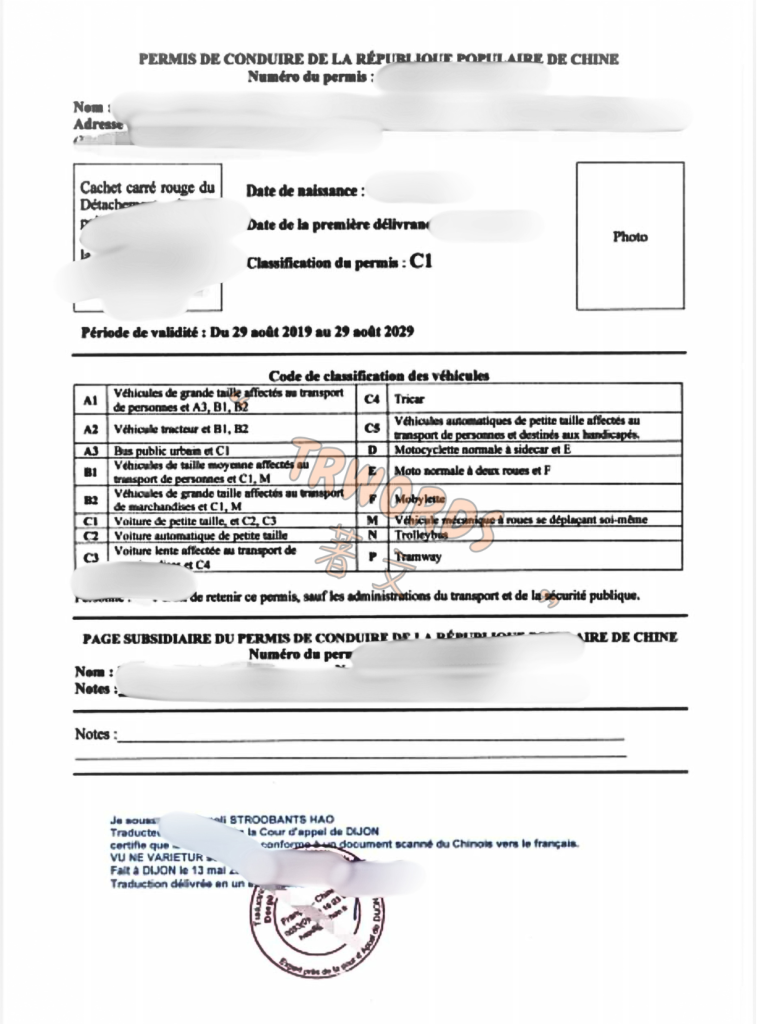
The format may vary slightly between translators, but a sworn translation will normally identify the translator and their status as a court-appointed expert. It will also include a certification statement, signature, stamp and a translation reference or number.
A copy of the source document is often attached to or reproduced with the translation. When a certified translation is submitted for legalization, France Diplomatie states that the original document and the translation should carry the translator’s stamp and signature, together with the same translation number.
The translator’s name and Court of Appeal can be checked against the official expert lists. This gives the receiving authority a way to verify who prepared and certified the translation.
Does a Sworn Translation Replace an Apostille or Legalization?
A sworn translation certifies the translation. It does not automatically authenticate the signature, seal or issuing authority shown on the original public document.
Depending on the country of issue, destination and receiving authority, a document may also require an Apostille or legalization. These are separate procedures.
How to Request a Chinese–French Sworn Translation
The process usually begins with a complete scan of the document and a short explanation of where it will be submitted. Applicants should also provide the required translation direction, deadline and any written instructions received from the authority.
Our Chinese-French Sworn Translation Service
We provide Chinese-French sworn translation for personal, academic, legal, driving, financial and commercial documents intended for official use in France.
Applicants can send a complete and clearly readable scan for an initial review. We will check the document type, number of pages, legibility and formatting requirements before confirming the translation arrangement.
Before placing an order, applicants should confirm whether the French authority requires a sworn translation, an Apostille or any additional formality. This helps ensure that the completed translation matches the procedure for which it will be used.