
Why Overseas Translations Are Often Rejected in China
Many people have already translated their documents overseas before submitting them in China. Some use a foreign translation agency, while others prepare the Chinese translation themselves.
In practice, Chinese government departments, courts, banks, schools and other institutions often reject these translations. Even when the wording is accurate, the receiving authority may be unable to verify the overseas translator, confirm the company’s registration or identify a responsible entity in China.
We have handled many cases in which applicants had to arrange a new translation after their overseas or self-prepared version was refused. For documents intended for formal use in China, it is generally safer to use a translation company legally registered in China.
What Is a Certified Chinese Translation?
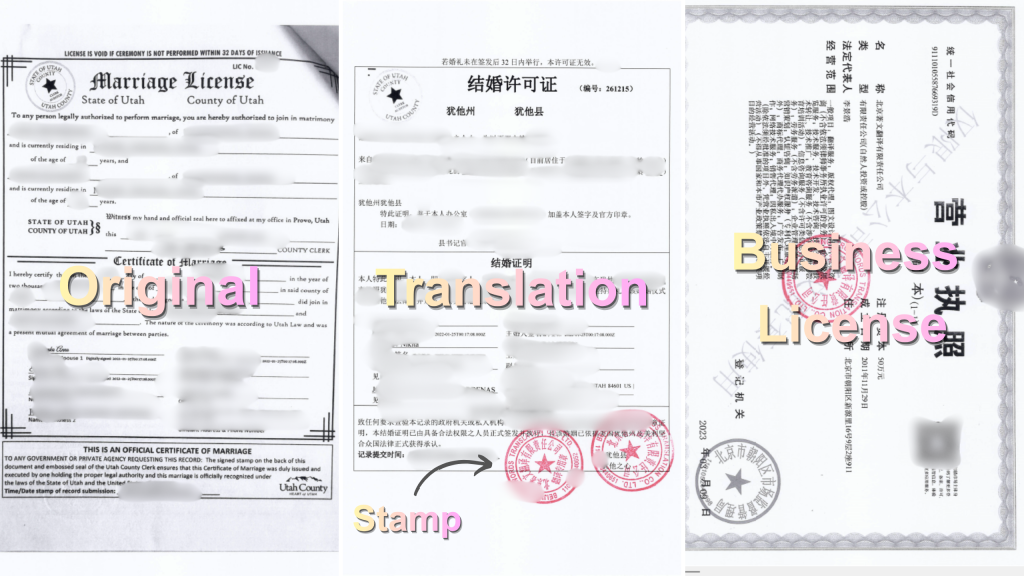
In this context, a certified Chinese translation is prepared by a China-registered translation company and issued under the company’s name. The Chinese translation bears the company’s official seal and is submitted together with supporting company documents.
A standard document package usually includes:
- a complete copy of the foreign-language document;
- a complete Chinese translation bearing the translation company’s official company seal;
- a copy of the translation company’s business licence bearing the same official company seal.
For multi-page documents, a cross-page seal may be required across the edges of the pages.
The precise format varies between authorities. Applicants should confirm the requirements before the translation is prepared.
Choosing a Translation Company in China
The translation provider should be a company formally registered in China. Its company name or registered business scope should include translation or translation services.
This allows the receiving authority to verify the company through its business licence. It also gives the translation a clear domestic entity responsible for the work.
A freelance translation or an overseas translation may still be linguistically accurate. It may face difficulties during submission because the Chinese receiving authority cannot readily verify the translator or hold a locally registered organization responsible.
The Entire Document Set Should Be Translated
The translation should normally cover every part of the document submitted. Translating only the main certificate or first page can leave the application incomplete.
Where the document has already been notarized, apostilled or legalized, the translation should also cover the relevant notarial wording, Apostille certificate, consular legalization page, seals, signatures, handwritten notes and attachments. Reverse-side entries and explanatory pages should also be included when they contain information.
Missing an Apostille or legalization page is a common problem. The receiving authority usually needs to understand the entire document chain, including how the foreign document was authenticated.
How Should Personal Names Be Translated?
Foreign personal names can generally remain in the original form shown in the passport or source document.
Two common exceptions arise when a foreign national uses an overseas driving licence in China or buys, sells or registers property in China. Vehicle administration and real estate registration systems may require a Chinese-character name for processing.
When a document contains the name of a Chinese citizen, the name should normally be translated or restored into Chinese. The translator should refer to the person’s Chinese passport, identity card or other reliable record where available.
Names, dates of birth and document numbers should be checked carefully before the translation is finalized. Differences between the foreign document and the identity document may require an explanation or additional supporting evidence.
Documents Commonly Translated for Use in China
Certified Chinese translations are commonly prepared for personal, academic, legal, corporate and financial documents. Typical examples include passports, birth certificates, marriage certificates, naturalization certificates, driver’s license, police clearance certificates, diplomas, degree certificates and transcripts.
They are also used for powers of attorney, court judgments, contracts, company registration records, articles of association, bank statements, employment documents, tax records, driving licences and driving records. Documents with an Apostille or consular legalization should be translated as a complete set.
Certified Translation and Notarized Translation
A company-stamped certified translation and a notarized Chinese translation are different forms of documentation. A certified translation is issued by the translation company, while a notarized translation involves a Chinese notary office and results in a notarial certificate.
Some receiving authorities accept a translation company’s sealed translation and business licence copy. Others may specifically request a notarized translation or a notarization confirming that the Chinese translation corresponds to the foreign-language document.
Applicants should follow the wording used by the receiving authority. When a notarized translation is expressly required, an ordinary company-stamped translation may not satisfy the requirement.
Our Certified Chinese Translation Service
We provide certified Chinese translations of foreign documents for use in China. The service can include a Chinese translation bearing our official company seal, a company-sealed copy of our business licence and cross-page sealing where required.
We can also assist with notarized Chinese translations when the receiving authority specifically requests a notarial certificate. Clear scans are usually sufficient for an initial review, and the final format can be arranged according to the stated submission requirements.
Pls feel free to contact us.