
Before looking for a notary public in China, ask yourself three questions: Where was your document issued, where will it be used, and what exactly does the receiving authority require?
For foreigners living or doing business in China, these questions are particularly important. Depending on your situation, you may need a Chinese notary office, your country’s embassy or consulate, or an Apostille or consular legalization procedure.
China also has its own notarial system, which differs from the notary systems used in many other countries. This guide explains the main options and how to identify the right procedure for your documents.
Foreign Documents for Use in China
If you have a document issued overseas and need to submit it to a Chinese authority or institution, you may need to complete authentication and Chinese translation before using it.
Common examples include:
- Foreign marriage certificates;
- Birth certificates and other personal records;
- Single Status Certificates;
- Foreign academic certificates;
- Police clearance certificates;
- Overseas company registration documents.
Apostille or Consular Legalization?
The authentication procedure depends on the country where the document was issued and whether the Apostille Convention applies between that country and China.
Documents from Apostille Convention countries
If the document was issued in a country where the Convention applies with China, it can generally be used in the Chinese mainland after obtaining an Apostille from the competent authority in the issuing country.
Documents from non-Apostille countries
If the Convention does not apply, the document generally needs to be authenticated by the relevant authorities in the issuing country, followed by legalization at the Chinese embassy or consulate there.
China implemented the Apostille Convention on November 7, 2023. This means that many foreign public documents can now be used in mainland China with an Apostille, without the traditional Chinese embassy legalization procedure.
Do Foreign Documents Need Chinese Translation?
Yes, a Chinese translation is commonly required when foreign-language documents are submitted to Chinese authorities or institutions. The exact format depends on the receiving organisation.
A commonly accepted format is a Chinese translation prepared by a translation company registered in China, bearing its official company seal and accompanied by a copy of its Business License bearing the company seal. Some authorities may also require the translator’s signature, contact details, an accuracy statement or other supporting information.

In certain cases, the receiving authority may require the translation itself to be notarized by a Chinese notary office. This may involve a notarization of the conformity of the translation with the original.
One important point: an Apostille authenticates the relevant signature, official capacity or seal. It does not certify the accuracy of the translation, so translation requirements must still be checked separately.
Chinese Documents for Use Overseas
If you have a document issued in the Chinese mainland and need to use it abroad, the procedure may involve Chinese notarization followed by an Apostille or consular legalization.
Common documents include:
- Certificate of No Criminal Record;
- Graduation Certificate and Degree Certificate;
- Academic Transcript;
- Powers of Attorney;
- Declarations;
- Corporate registration documents and resolutions.
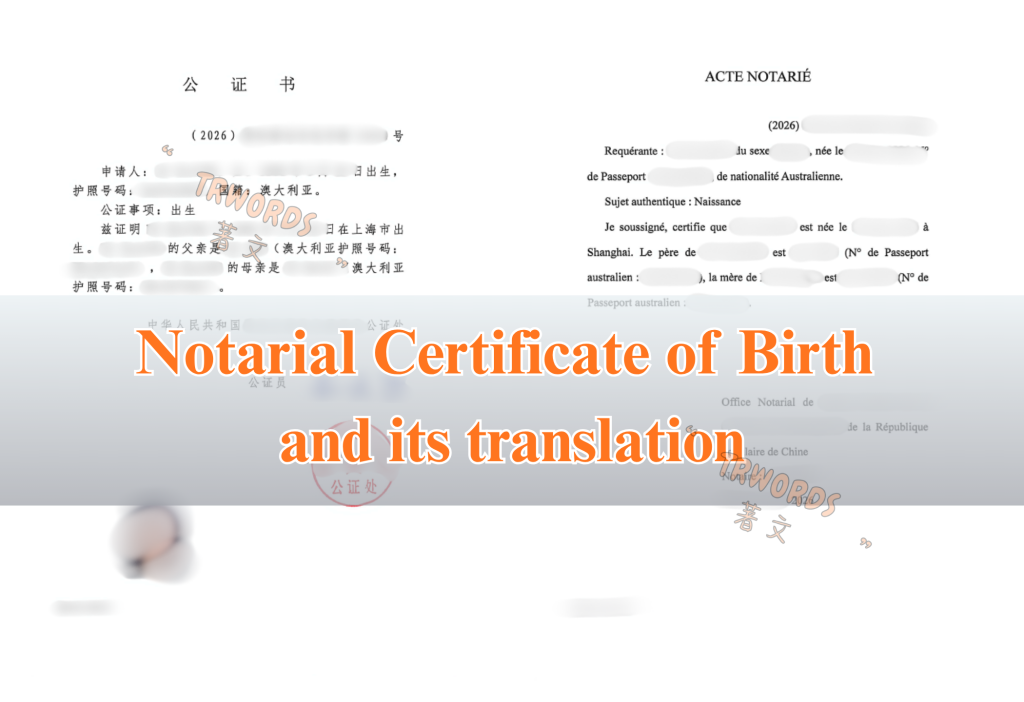
For many personal documents, the usual starting point is a Chinese notarial certificate issued by a notary office. Some other public or commercial documents may be processed through the relevant competent authority or certification institution like CCPIT, depending on their nature.
Apostille for Overseas Use
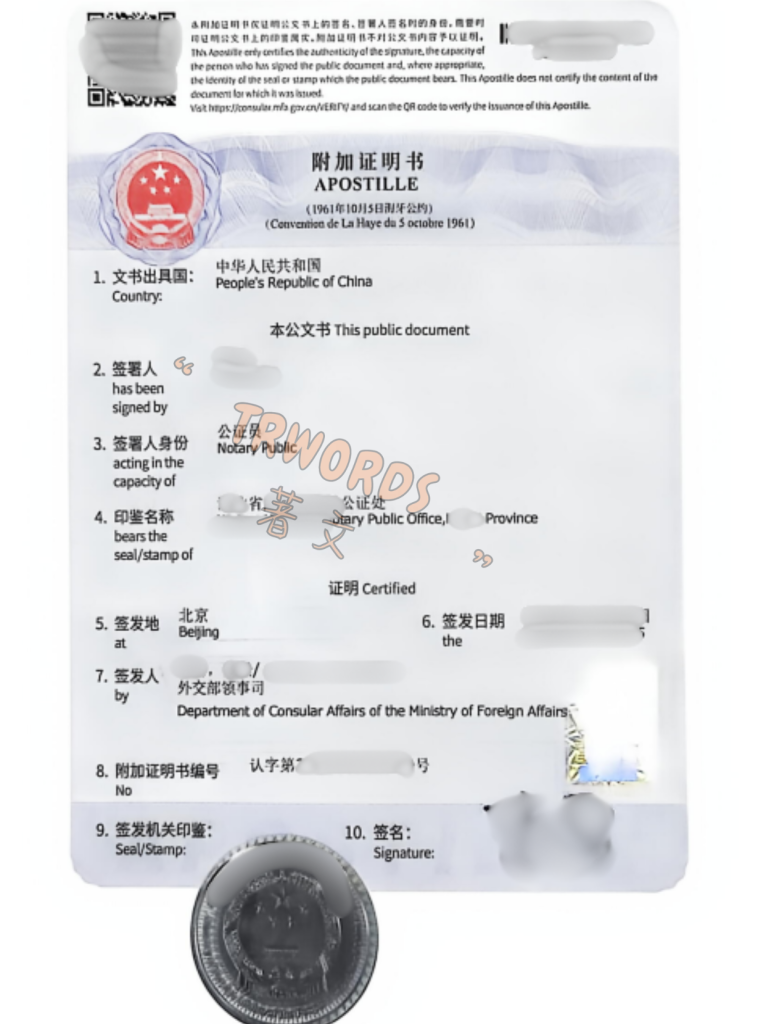
If the destination country applies the Apostille Convention with China, the relevant Chinese public document can generally be submitted for a China Apostille after the required notarization or competent-authority verification.
The Apostille is issued by China’s Ministry of Foreign Affairs or an authorised local Foreign Affairs Office, depending on the document and its place of issuance.
Consular Legalization for Non-Apostille Destinations
If the destination country does not apply the Apostille Convention with China, traditional consular legalization may be required. The general procedure involves:
- Chinese notarization by notary offices;
- Authentication by China’s Ministry of Foreign Affairs or an authorised Foreign Affairs Office;
- Legalization by the destination country’s embassy or consulate in China.
Not every document requires further authentication. Some receiving institutions accept a Chinese notarial certificate directly, so it is important to confirm the exact requirements before proceeding.
Need a Document Notarized for Use in Your Home Country?
Foreigners living in China sometimes need documents notarized for use in their home countries. For example, you may need to sign a Power of Attorney for a property transaction, prepare a declaration for a legal matter or complete paperwork requested by a bank or government department.
There are several possible ways to handle this, depending on your nationality and the receiving authority’s requirements.
Notarial Services at Your Embassy or Consulate
Some foreign embassies and consulates in China provide notarial services to their nationals. These may include witnessing signatures, administering oaths or certifying certain documents.
However, services differ between diplomatic missions. Check whether your embassy offers the specific service you need, whether an appointment is required and whether the resulting document will be accepted by the organisation receiving it.
Notarization at a Chinese Notary Office
In some cases, a Chinese notary office may be able to notarize a document or legal act for use overseas. For example, an applicant may need to sign a Power of Attorney or declaration before a Chinese notary.
The appropriate procedure depends on the document, the applicant’s circumstances and the requirements of the destination country. Always confirm whether the receiving authority accepts this form of notarization before proceeding.
Three Common Types of Notarization in China
China has a relatively broad notarial system. Under the Notarization Law of the People’s Republic of China, a notarial institution may certify the authenticity and legality of civil legal acts, facts and documents of legal significance.
For practical purposes, common notarization requests can be understood in three broad categories. These are explanatory categories rather than a complete statutory classification.
Notarization of Legally Relevant Facts
This type of notarization concerns the existence or truth of a particular fact. The notary office examines the relevant supporting materials and issues a notarial certificate confirming the fact.
A common example for foreign applicants is:
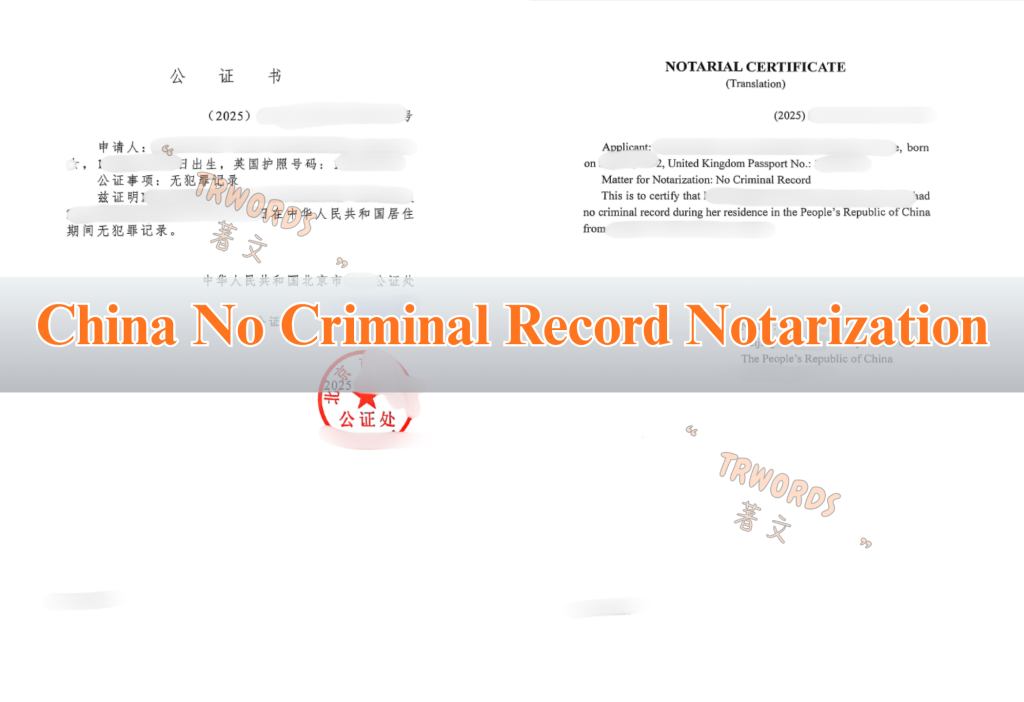
- Notarization of the Fact of No Criminal Record
In this case, the notary office certifies that the applicant had no criminal record in China during the specified period, based on the relevant police records and supporting evidence.
Notarization of Documents and Certificates
This type of notarization concerns an existing document or certificate and what can be established about it. The notary office examines the original document and relevant supporting materials before determining the appropriate notarial statement.
Common examples include:
- Notarization of a Police-Issued Certificate of No Criminal Record;
- Notarization of the Conformity of a Copy with the Original;
- Notarization of the Conformity of a Translation with the Original.
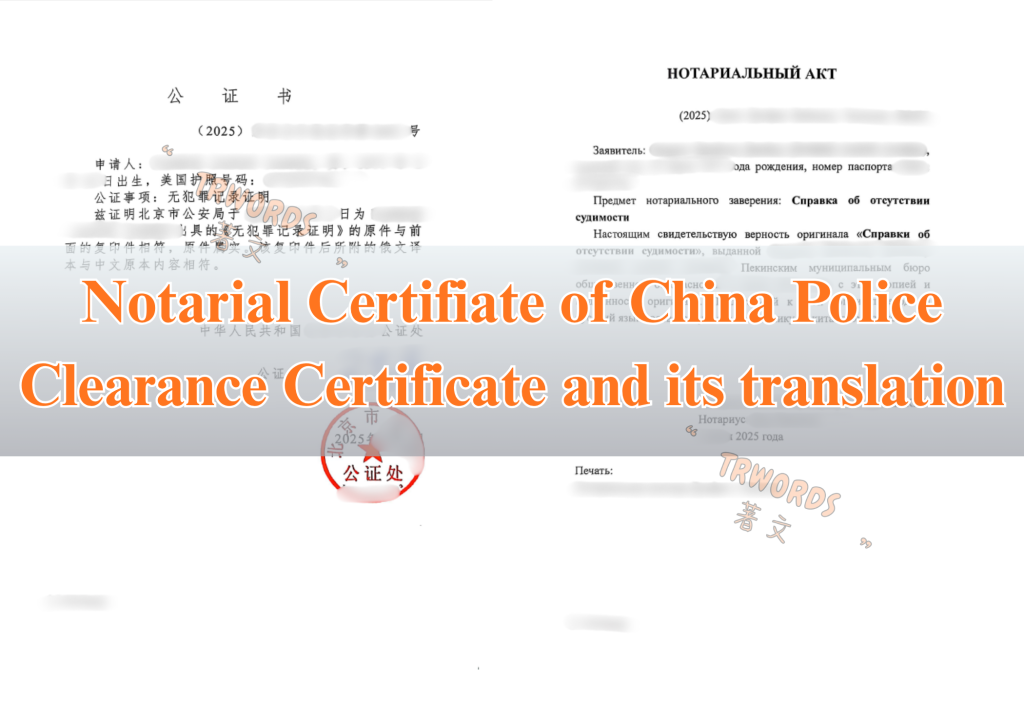
For example, when a police-issued Certificate of No Criminal Record is notarized, the notarial certificate may include a photocopy of the police document and its corresponding translation. The precise meaning of the notarization depends on the notarial statement: it may establish that the copy conforms to the original and that the original is authentic, rather than independently certifying the underlying criminal record information.
Document notarization involves examination of the original and supporting evidence. It is not simply a matter of photocopying a document and having the copy stamped.
Notarization of Legal Acts
Chinese notary offices can also notarize certain legal acts performed by individuals or organisations. This generally involves examining the parties’ identities, legal capacity, intentions and the relevant documents.
Common examples include:
- Powers of Attorney;
- Declarations;
- Contracts and agreements;
- Wills;
- Property-related legal acts.
Signature notarization can also fall into this category. For example, when a person signs a Power of Attorney in front of a notary, the notary may notarize the signing of that document as a legal act, subject to the applicable requirements.
Why Does the Type of Notarization Matter?
Different notarial certificates may look similar, but their statements can establish different things. This is particularly important when documents are submitted to foreign authorities.
For example, a receiving institution may require proof of the fact that an applicant has no criminal record. Another institution may specifically request notarization of the police-issued Certificate of No Criminal Record itself.
These requirements can lead to different notarial procedures. Before applying, confirm exactly what the receiving authority needs so that the correct type of certificate can be prepared.
Apostille or Consular Legalization: Which One Do You Need?
Apostille and consular legalization are two different authentication routes for public documents intended for international use. The correct route depends primarily on the relationship between the issuing country and the destination country under the Apostille Convention.
| Apostille | Consular Legalization | |
| Applicable situation | The Convention applies between the relevant countries | The Convention does not apply |
| Issuing authority | Competent Apostille authority | Relevant government authentication authority and destination country’s embassy or consulate |
| Purpose | Authenticates the relevant signature, official capacity and seal | Authenticates the relevant signature, official capacity and seal through the traditional legalization chain |
An Apostille does not verify the factual contents of a document or the accuracy of its translation. It confirms the origin of the public document for international use under the Convention.
For documents issued in mainland China, the Ministry of Foreign Affairs or an authorised Foreign Affairs Office handles Apostille applications. For documents issued overseas, the Apostille must be obtained from the competent authority in the issuing country.
Common Mistakes When Arranging Notarization in China
Foreign applicants often encounter problems because the required procedure has not been confirmed before documents are prepared. Here are some common mistakes to avoid.
Choosing the wrong type of notarization
A notarization of the fact of no criminal record and a notarization of the police-issued certificate have different subjects of proof. Always check which one the receiving authority requires.
Confusing notarization with Apostille
Apostille and notarization serve different purposes. Depending on the document and the receiving authority, notarization or verification may need to take place before an Apostille can be issued.
Submitting an incomplete translation
The main document may have been translated, but the notarial statement, Apostille page, signatures or official seals may have been omitted. Make sure the complete document package is translated when required.
Assuming every embassy offers the same notarial services
The services provided by foreign embassies and consulates in China vary. Check the relevant diplomatic mission’s requirements before making an appointment.
Following a general procedure without checking the receiving authority’s instructions
The same type of document may be accepted in different formats depending on its intended use. Confirm the required language, notarial form, authentication and validity period before starting.
How True Words Translation Can Help
True Words Translation provides document translation and notarization-related services for foreign individuals and businesses dealing with documents in China.
Our main services include:
Certified Translation Services
- Translation of foreign documents into Simplified Chinese;
- Translation of Chinese documents into English and other languages;
- Company-stamped translations with a copy of our Business License where required;
- Translation of Apostille and consular legalization documents.
China Police Clearance Services
- Assistance with obtaining a Chinese Certificate of No Criminal Record;
- Translation into English, Spanish, Russian, Portuguese, Korean and other languages;
- Notarization of the fact of no criminal record;
- Notarization of police-issued certificates;
- Apostille and consular legalization.
Academic Document Services
- Translation of foreign academic documents;
- Notarization of eligible foreign academic documents in China;
- Notarization of Chinese Graduation Certificates, Degree Certificates and Academic Transcripts;
- Apostille and consular legalization where required.
Notarization of Translation Conformity
- Notarization of the conformity of a translation with the original;
- Assistance with foreign documents requiring a Chinese notarial certificate confirming translation conformity.
Before proceeding, please confirm the exact document, translation, notarization and authentication requirements with the relevant receiving authority or your immigration, visa or legal adviser.
Once you have confirmed the requirements, we can provide the corresponding translation, notarization, Apostille or consular legalization services based on those instructions.