
If you graduated from a university in China and plan to study, work or immigrate abroad, you may need to have your academic documents notarized before submitting them to a foreign university, employer or government authority.
The process can be arranged remotely, even if you have already left China. However, there are a few important details to understand, particularly the difference between Graduation Certificate notarization, Degree Certificate notarization and Academic Transcript notarization.

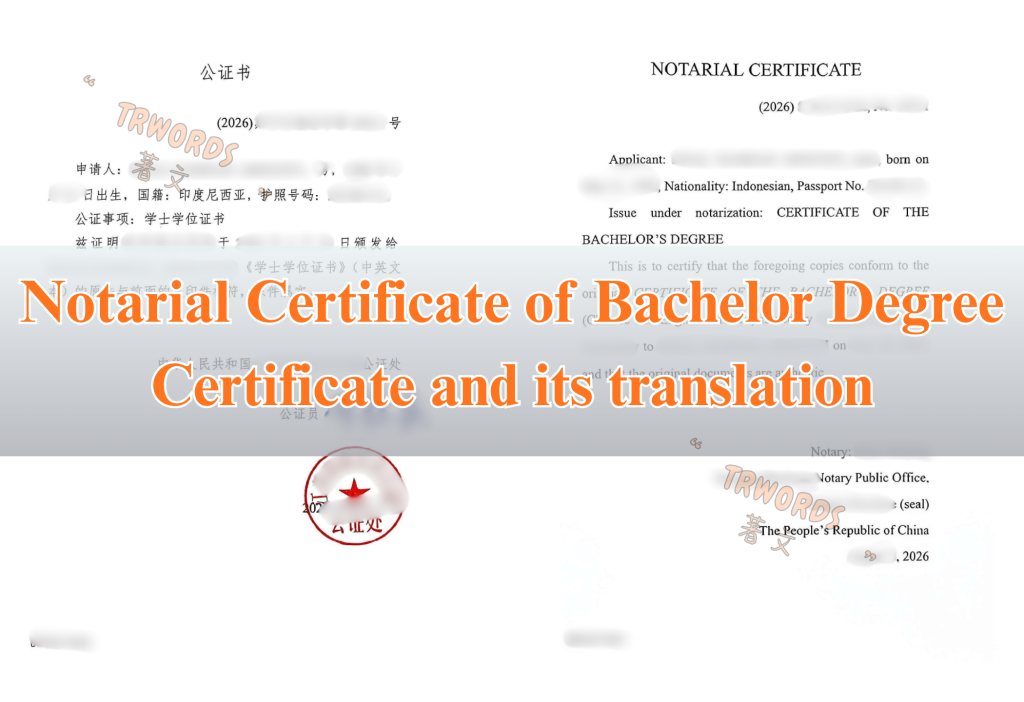
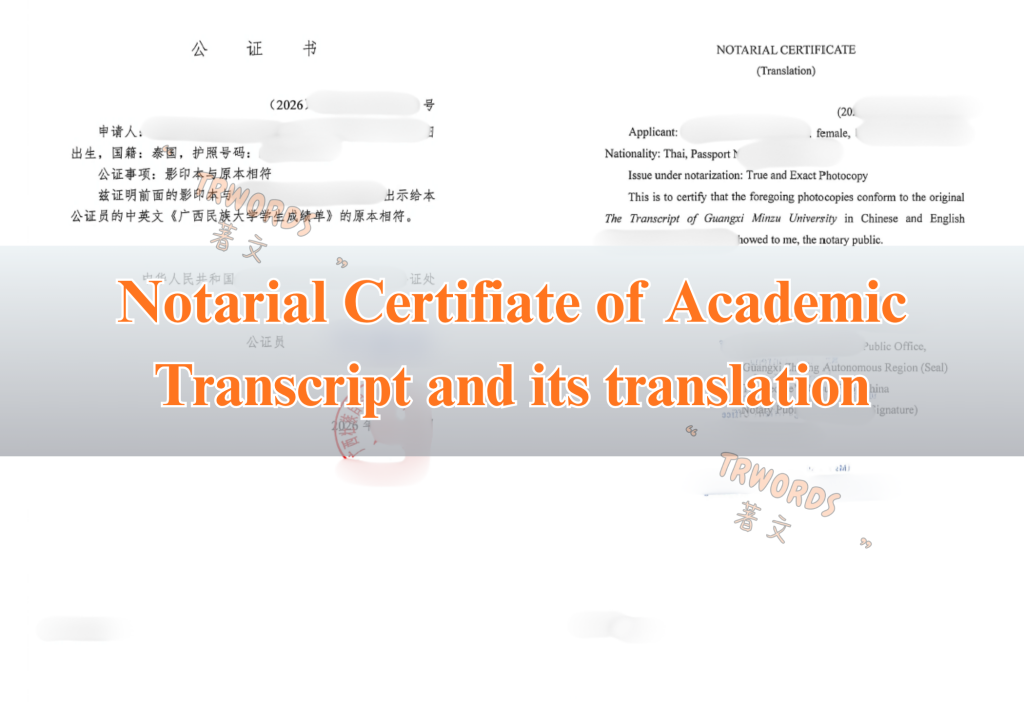
Which Academic Documents Can Be Notarized?
Chinese universities generally issue two separate certificates to undergraduate graduates: a Graduation Certificate (毕业证) and a Degree Certificate (学位证). An Academic Transcript (成绩单) is a separate record of the courses taken and grades achieved.
These documents serve different purposes:
- Graduation Certificate: Confirms that you have completed your university programme and graduated.
- Degree Certificate: Confirms that the university has awarded you an academic degree, such as a Bachelor of Engineering or Bachelor of Science.
- Academic Transcript: Records your courses, credits, grades and other academic results.
Overseas universities and other receiving institutions may request all three documents. Before arranging notarization, check whether you need all of them or only specific certificates.
What Is Chinese Academic Document Notarization?
Chinese academic document notarization is carried out by a Chinese notary office. The notary office examines the relevant academic documents and issues a formal notarial certificate for overseas use.
Depending on the type of notarization and the language required, the notarial certificate generally includes a copy of the original academic document, the corresponding translation and the notarial statement. The translation can be prepared in English, French, Spanish, Arabic or other languages, subject to the notary office’s capabilities and the receiving authority’s requirements.
A Chinese notarial certificate is different from an ordinary translation stamped by a translation company. It is an official notarial document issued by a Chinese notary office.
What Documents Do You Need?
For an initial review, we generally need clear scanned copies of the following:
- Graduation Certificate, if applicable;
- Degree Certificate, if applicable;
- Academic Transcript, if required;
- Passport information page;
- Chinese visa or residence permit page;
- Previous passport information, if you have renewed your passport since studying in China.
Do you need to send the original certificates?
For Graduation Certificate and Degree Certificate notarization, clear scans are generally sufficient. There is normally no need to mail the original certificates to China.
Academic Transcripts are slightly different. In most cases, a clear scan is also sufficient, but some notary offices may require the original transcript to be mailed for verification. We check this requirement before starting the application.
Do you need a CHSI verification report?
CHSI (学信网) is China’s official platform for higher education student and degree information. We can check the relevant academic records through CHSI during our preliminary review, so you normally do not need to obtain a verification report yourself.
If your information cannot be accessed because you have not registered a CHSI account or linked your degree information, we may ask you to register and complete the necessary identity verification. This helps the notary office verify your academic records.
Why Is Academic Transcript Notarization Different?
This is one of the most important details when arranging Chinese academic notarization.
China generally follows territorial jurisdiction rules for notarization. However, since 1 January 2021, the Ministry of Justice has introduced nationwide cross-provincial processing for certain matters, including Graduation Certificate notarization and Degree Certificate notarization. These two types of notarization can be handled by eligible notary offices anywhere in China, regardless of the applicant’s household registration or the university’s location.
Academic Transcript notarization is not included in this nationwide arrangement. In practice, it generally needs to be handled by a notary office with jurisdiction over the place where the transcript was issued, usually the city where the university is located.
For example, a graduate from a university in Liaoning may be able to have their Graduation Certificate and Degree Certificate notarized through an eligible notary office in another province. Their Academic Transcript, however, will generally need to be notarized in Liaoning.
This distinction becomes particularly important if the documents will later need a China Apostille or consular legalization. If a transcript is notarized by a notary office without the proper jurisdiction, the issue may arise at the subsequent authentication stage, and the document may be refused for further processing.
What if your university issued an English transcript?
Not all Chinese notary offices follow the same requirements. Some offices, including certain notary offices in Jiangsu, can accept English-language transcripts. Others, such as the notary office handling our cases in Liaoning, may require a Chinese transcript issued by the university.
If you only have an English transcript, you may need to contact your former university and request a Chinese version before notarization. We recommend checking this requirement in advance, particularly if you graduated several years ago or have already left China.
Can You Apply After Leaving China?
Yes. You do not need to return to China simply because you have already graduated and moved overseas.
You can send us scanned copies of your academic documents and passport for preliminary review. We coordinate with the appropriate notary office, check the verification requirements and arrange the notarization remotely.
The territorial jurisdiction rules still apply, especially to Academic Transcripts, but they do not mean that you must personally travel back to your university city. We can coordinate the necessary procedures in China and arrange international delivery after completion.
This is particularly convenient for international graduates who only discover the notarization requirement when applying for postgraduate studies, overseas employment or immigration several years after graduation.
Do You Need an Apostille or Consular Legalization?
Chinese notarization is generally the first step when Chinese academic documents are intended for overseas use. Whether further authentication is necessary depends on the destination country and the requirements of the receiving institution.
Apostille
If your documents will be used in a country where the Apostille Convention applies with China, and the receiving authority requires authentication, you can apply for a China Apostille after notarization.
China began implementing the Convention on 7 November 2023. The Apostille replaces the traditional consular legalization procedure between countries where the Convention applies.
Consular Legalization
For countries where the Apostille Convention does not apply with China, the traditional consular legalization route may be required. This generally involves authentication by the Chinese Ministry of Foreign Affairs or an authorised Foreign Affairs Office, followed by authentication by the destination country’s embassy or consulate in China.
However, not every destination country or institution requires further authentication. Some accept Chinese notarial certificates directly, so always confirm the exact requirements before arranging an Apostille or legalization.
Translation Languages, Processing Time and Delivery
Translation languages
We can arrange notarial certificates in English, French, Spanish, Arabic and other languages according to your requirements. The appropriate language should be confirmed with the receiving institution before the application starts.
Processing time
Typical reference times are:
- Chinese notarization: approximately 5–7 working days.
- China Apostille: approximately 5 additional working days.
- Consular legalization: varies depending on the destination country’s embassy or consulate.
These are estimated timeframes rather than guaranteed completion dates. Additional verification, original-document requirements or embassy processing may extend the overall period.
Document delivery
Once the notarial certificates are completed, we first send you scanned copies for reference. The original paper certificates are then dispatched by courier to your designated address in China or overseas.
How to Arrange Your Chinese Academic Notarization
The process is straightforward:
- Send us clear scans of your academic documents and passport.
- Tell us the destination country, intended use and required translation language.
- We review the documents, check CHSI information and confirm the appropriate notarial procedure.
- We arrange notarization and any required Apostille or consular legalization.
- We send you scanned copies and courier the original paper certificates.
True Words Translation assists international graduates with Chinese Graduation Certificate, Degree Certificate and Academic Transcript notarization, as well as subsequent Apostille and consular legalization.
Whether you are still in China or have already returned home, we can help you prepare your Chinese academic documents for overseas use without making a separate trip back to China.
Contact us to have your documents reviewed before starting the process.