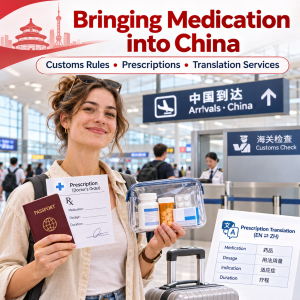
If you take regular medication or need prescription drugs during your stay in China, you may be wondering whether you can bring them with you. In general, travellers can bring a small quantity of medication for personal use, but certain medicines are subject to strict controls or are prohibited from entering China.
Here is what you should know before travelling.
Which Medicines Can You Bring into China?
Ordinary medicines that do not contain controlled narcotic or psychotropic substances can generally be brought into China in reasonable quantities for personal use, subject to customs supervision.
Common examples include:
- Allergy and cold medications;
- Pain relievers and fever reducers;
- Medication for high blood pressure;
- Diabetes medication;
- Other medicines prescribed for ongoing medical conditions.
There is no single universal quantity limit for all ordinary medicines. Customs considers whether the quantity is reasonable for personal use, taking the individual circumstances and purpose of travel into account.
For prescription medication, it is advisable to carry your doctor’s prescription or a medical letter explaining the treatment. Check the active ingredients before travelling, as some products sold freely in other countries may contain substances subject to special controls in China.
Which Medicines Are Restricted or Prohibited?
This is particularly important because a medicine that is legally prescribed in your home country may still be subject to different regulations in China.
Narcotic drugs and psychotropic substances
China exercises strict controls over narcotic drugs and psychotropic substances. However, certain medicines in these categories may be carried for personal medical treatment under specific conditions.
Under Article 44 of China’s Regulations on the Administration of Narcotic Drugs and Psychotropic Substances:
- Individuals carrying narcotic drugs or Category I psychotropic substances for medical treatment must have a medical diagnosis certificate issued by a medical institution and valid identification.
- The quantity must not exceed the maximum amount permitted under a single prescription.
- For Category II psychotropic substances, the prescribed quantity may be extended where appropriate.
Travellers should also carry supporting documents such as prescriptions and medical records and proactively declare controlled medication to Customs.
For example, methylphenidate, the active ingredient in Concerta, is classified as a Category I psychotropic substance in China. If you take ADHD medication or other controlled prescription drugs, check their Chinese classification before travelling.
Prohibited substances
Some substances are prohibited from entering China. Cannabis is a particularly important example. According to Shanghai Customs, cannabis, including medical cannabis containing THC, is prohibited from entering China even when it has been legally prescribed by a doctor overseas.
A foreign prescription does not override China’s restrictions. If you are unsure whether your medication contains a prohibited or controlled substance, check with the relevant Chinese authorities before departure.
Should Medication Be in Its Original Packaging?
We recommend keeping medication in its original packaging whenever possible. The packaging and labels help identify the product, its active ingredients, strength, manufacturer and dosage.
Avoid carrying loose, unidentified tablets or mixing different medicines into unlabelled containers. If you use a pill organiser for daily doses, keep the original packaging available for reference.
Although the general personal-use rule does not impose a universal original-box requirement for every ordinary medicine, keeping the packaging makes customs inspection and identification easier.
It is also helpful to prepare:
- Your doctor’s prescription;
- A medical diagnosis certificate or doctor’s letter, where relevant;
- Medical records explaining long-term treatment, if available;
- Your passport or other valid identification.
For controlled medicines, follow the specific documentation and quantity requirements described above.
Do You Need a Chinese Translation of Your Prescription?
If your prescription or medical documents are issued in English or another foreign language, a Chinese translation can help explain your medication when questions arise during customs inspection.
This is particularly useful when the documents contain medical terminology, unfamiliar drug names or dosage instructions. Important information includes:
- Generic drug name and active ingredients;
- Dosage and strength;
- Instructions for use and frequency;
- Patient information;
- Doctor and medical institution details;
- Diagnosis and treatment information, where relevant.
A translation helps customs officers understand the documents, but it does not replace a required medical diagnosis certificate, other supporting documents or any applicable import restrictions.
Chinese Translation Services for Medical Documents
We provide translation services for foreign medical documents, primarily from English and other foreign languages into Simplified Chinese.
Our services include:
- Prescription Translation: Translation of prescriptions issued by overseas doctors;
- Medical Certificate Translation: Translation of medical diagnoses and certificates;
- Doctor’s Letter Translation: Translation of letters explaining a patient’s condition and ongoing treatment;
- Medication Leaflet Translation: Translation of medicine instructions, ingredients, dosage and precautions.
We can also arrange Chinese-to-English or other English-language translation services depending on the purpose and document requirements.
Our focus is on accurately translating medication names, active ingredients, dosages and medical instructions so that the Chinese version clearly reflects the original medical information.
Before You Travel to China
A little preparation can help avoid unnecessary difficulties at the airport.
- Check the active ingredients in your medication and whether they are controlled or prohibited in China.
- Bring only a reasonable quantity for personal use.
- Keep medicines in their original packaging where possible.
- Carry your prescription and relevant medical documents.
- Prepare Chinese translations if your documents are in another language.
- Declare controlled medication to Customs as required.
If you take regular medication, do not wait until you arrive at the airport to check whether it can be brought into China. The rules depend on the ingredients and classification of the specific medicine, and Customs retains the authority to assess and inspect the items carried by travellers.