
A foreign graduate may have three documents from the same Chinese university: a Graduation Certificate, Degree Certificate and Academic Transcript. It is easy to assume that all three can be notarized through the same notary office.
In practice, the transcript is often the document that requires more careful planning. The reason lies in China’s rules on notarial jurisdiction.
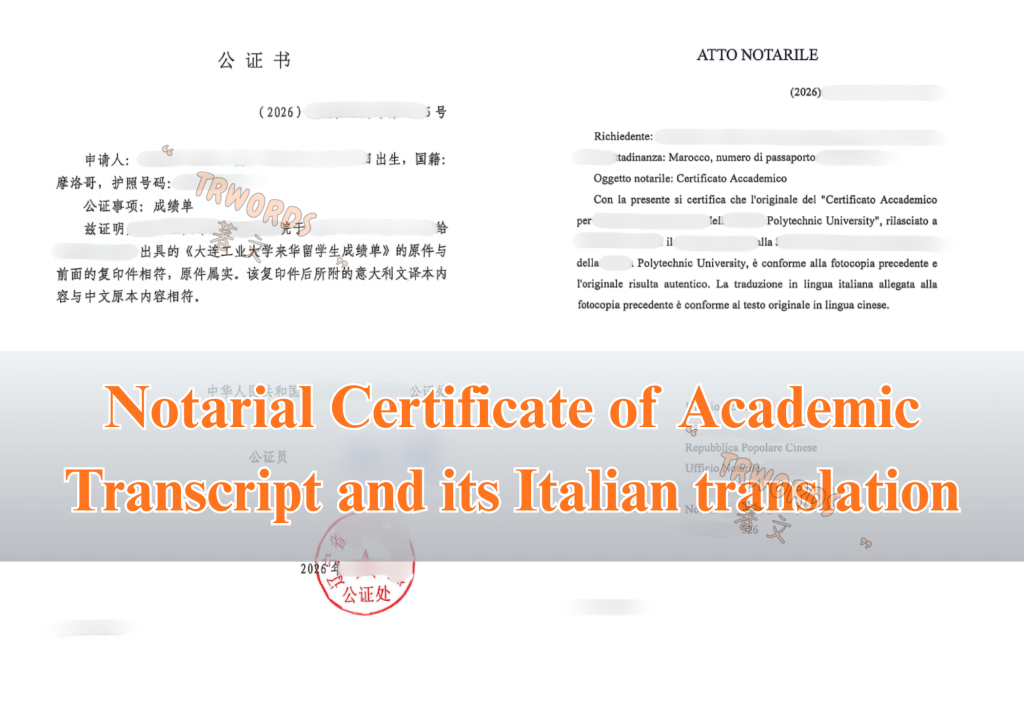
Chinese Notarization Normally Follows Territorial Jurisdiction
As a general rule, Chinese notary offices handle matters connected with their authorised geographical area. The applicant, the relevant fact or the document itself normally needs an appropriate connection with the notary office’s jurisdiction.
This is particularly convenient for foreign graduates who have already left the city where they studied—or have left China altogether.
Academic Transcripts Are Not Included in the Exception
An Academic Transcript is treated differently. Transcript notarization is not included among the nationwide cross-provincial notarization matters, so the ordinary jurisdiction rules still apply.
In practice, this generally means that the transcript should be notarized where the document was issued, usually in the city or province where the university is located.
For example, a graduate from a university in Liaoning may be able to have the Graduation Certificate and Degree Certificate notarized through an eligible notary office elsewhere in China. The Academic Transcript, however, would normally need to be handled by a notary office with jurisdiction over the university in Liaoning.
This means that three documents from the same university do not necessarily have to be notarized by the same notary office.
Why the Correct Location Matters for Apostille or Legalization
This becomes especially important when the transcript will later need a China Apostille or consular legalization.
China’s Ministry of Foreign Affairs confirms that Graduation Certificates, Degree Certificates and Academic Transcripts issued by Chinese educational institutions cannot proceed directly to Apostille or consular legalization. They must first be notarized by a Chinese notary office.
For transcripts, choosing the correct notary office at the beginning is therefore important. In our handling experience, if a transcript is notarized outside the proper jurisdiction, the problem may only become apparent at the next stage, when the document is submitted for authentication and is refused because the notarization did not follow the required territorial jurisdiction.
Simply obtaining a notarial certificate is therefore not always enough. If the document will continue to Apostille or consular legalization, the entire document chain needs to be valid from the first step.
If You Need All Three Documents, Check the Transcript First
When a foreign graduate needs a Graduation Certificate, Degree Certificate and Academic Transcript for overseas use, the transcript is often the document that determines how the case should be arranged.
Graduation Certificate and Degree Certificate notarization offer much more flexibility because they can be processed across provincial boundaries. The transcript usually needs to follow the university’s location, so it is worth confirming the issuing city before any of the documents are submitted.
This small distinction can prevent a much bigger problem later. If the completed notarial certificates will proceed to a China Apostille or consular legalization, getting the transcript jurisdiction right from the beginning can save the applicant from having to notarize the same document again.