
If you need to use a foreign marriage certificate for a China visa, visa extension, residence permit, or family-related application, you may be asked to provide the document in a format that can be reviewed by the relevant Chinese authority.
Depending on where you submit the application, this may involve a stamped Chinese translation with a business license copy of the translation company, or a notarized translation of the marriage certificate.
These requirements can vary. Some applicants submit documents to a Chinese embassy, consulate, or visa center overseas. Others submit documents to an exit-entry administration office in China, such as in Beijing, Shanghai, Guangzhou, Shenzhen, Hangzhou, Chengdu, or another city. The required format depends on the visa type, the issuing country of the marriage certificate, the receiving authority, and the officer’s review of the case.
We do not determine visa or immigration requirements. The final document requirements are decided by the relevant embassy, consulate, visa center, exit-entry office, or receiving authority. Our role is to help prepare the translation or notarized translation according to the format requested.
When Might a Marriage Certificate Be Used?
A marriage certificate may be used as proof of family relationship in different China-related applications.
Common situations include:
- China visa applications,
- Q2 or S2 family visit applications,
- visa extension or renewal in China,
- family reunion residence permit applications,
- private affairs residence permit applications,
- spouse-related applications,
- and other cases where the applicant needs to prove a marital relationship.
For example, a foreign spouse may need to show a marriage certificate when applying to visit a Chinese citizen, extend a family visit visa in China, or apply for a residence permit based on family reunion. In other cases, a foreign-issued marriage certificate may be submitted as supporting evidence for a visa or residence document.
Because each authority may review documents differently, applicants should confirm whether they need a stamped translation, a notarized translation, or additional authentication before submission.
Stamped Chinese Translation with Business License Copy
One common requirement is a Chinese translation prepared by a formal translation company.
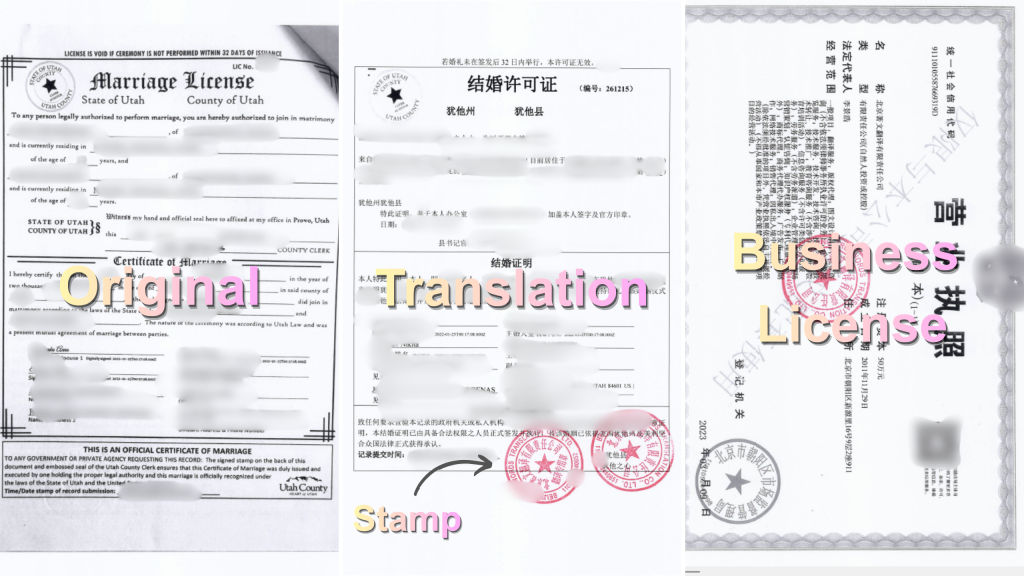
In this case, the receiving authority may ask for a stamped Chinese translation together with a copy of the translation company’s business license. This helps show that the translation was prepared by a registered service provider and can be traced to a specific company.
We can provide a stamped Chinese translation of your marriage certificate with a business license copy of the translation company upon request.
This service may be useful when submitting documents to an exit-entry administration office in China, a visa center, or another authority that asks for a formal translation provider’s stamp and company qualification document.
A stamped translation may include:
- a complete Chinese translation of the marriage certificate,
- translation of seals, stamps, and remarks,
- the translation company’s official stamp,
- and a copy of the translation company’s business license.
This type of translation is often suitable when the authority mainly needs to understand the contents of the foreign marriage certificate in Chinese.
Notarized Translation of a Marriage Certificate
In some cases, a stamped translation may not be enough. The receiving authority may ask for a more formal document, such as a notarized translation of the marriage certificate.
A notarized translation usually refers to a notarial certificate confirming that the Chinese translation conforms to the original marriage certificate. In Chinese practice, this is often called translation accuracy notarization or a notarial certificate for consistency between the translation and the original document.
This type of document may be requested when the authority wants a notary office to confirm the relationship between the original document and its Chinese translation. It may also be used when the applicant wants to submit a more formal version of the translated document for visa, residence, or immigration-related purposes.
We can assist with notarized translation of foreign marriage certificates where this format is required or preferred by the receiving authority.
The notarial certificate includes the Chinese translation, the copy of the original marriage certificate, and the notary wording confirming that the translation is consistent with the original document. The exact format may vary depending on the notary office and document type.
Which Option Do You Need?
The right option depends on the instruction given by the receiving authority.
If the authority asks for a translation company stamp and business license copy, a stamped Chinese translation may be appropriate.
If the authority asks for a notarized translation, translation accuracy notarization, or a notarial certificate confirming that the translation matches the original, then a notarized translation may be needed.
If the authority asks for authentication of the original foreign marriage certificate itself, translation alone may not be enough. Depending on the country of issue and the place of use, the original certificate may also need notarization, Apostille, or consular legalization.
Before starting, it is helpful to check the exact wording of the requirement. Phrases such as “Chinese translation,” “certified translation,” “translation company stamp,” “business license copy,” “notarized translation,” “notarial certificate,” “Apostille,” and “legalization” can refer to different document routes.
If you are unsure, you can send us the instruction you received, and we can help you understand which type of document preparation may match that request.
What Should the Translation Include?
A marriage certificate translation should be complete and consistent with the original document.
The translation should usually include:
- the full names of both spouses,
- date of birth or nationality, if shown,
- date of marriage,
- place of marriage,
- certificate number or registration number,
- issuing authority,
- date of issue,
- official seals and stamps,
- signatures or officer names, if shown,
- and any remarks, amendments, or handwritten notes.
Names and dates should be checked carefully. If the name on the marriage certificate differs from the current passport, the applicant may need additional supporting documents, such as a previous passport, name change certificate, or written explanation.
For certificates issued in countries with different naming systems, the translation should handle name order, middle names, accents, and spelling consistently.
Our Service
We provide marriage certificate translation and notarized translation services for China visa, visa extension, residence permit, and other family-related document use.
Before placing an order, please confirm with the receiving authority whether you need a stamped Chinese translation with a business license copy or a notarized translation of the marriage certificate.
Once you confirm the required format, you can send us a clear scan of your marriage certificate and any written instructions you have received. We will prepare the document according to the format you request.
Frequently Asked Questions
Do I need a stamped translation or a notarized translation?
It depends on the receiving authority. Some authorities may ask for a stamped Chinese translation with a business license copy. Others may request a notarized translation or a notarial certificate confirming that the translation conforms to the original marriage certificate.
Can you provide a business license copy with the translation?
Yes. If required, we can provide a stamped Chinese translation with a copy of the translation company’s business license.
What is a notarized translation of a marriage certificate?
It is usually a notarial certificate confirming that the Chinese translation is consistent with the original marriage certificate. The exact format may depend on the notary office and the receiving authority’s requirements.
Can this be used for Q2 visa or residence permit applications?
It may be used for China visa, Q2 or S2 family visit, visa extension, residence permit, and other family-related applications, depending on the receiving authority’s requirements.
Do I also need Apostille or legalization?
Possibly. If the receiving authority needs to verify the original foreign marriage certificate itself, the document may need notarization, Apostille, or consular legalization in addition to translation. This depends on the issuing country and the place of use.
Need Help Preparing Your Marriage Certificate?
If you need to use a foreign marriage certificate for a China visa, visa extension, residence permit, or family-related application, we can help prepare the required translation format.
Send us your marriage certificate online. We can provide a stamped Chinese translation with a business license copy or assist with a notarized translation if that format is requested.